Alan Strang from Equus
INFJ
by Rebecca
requested by @partlycloudyday

Introverted Intuition (Ni)
“I wish I was a cowboy. They’re free. They just swing up and then it’s miles of grass…”
Alan demonstrates a complicated but intense inner world that causes his to develop a religion toward horses and break out into violence. Throughout the play, the sources of Alan’s religion become clear, stemming from certain and definitive sources. Though unusual and unique to Alan himself, the development of his horse worship comes from riding a horse when he was young and stories from his mother. Alan’s religion is full and complex, with its own internal rules and concepts that he accepts fully. His inner self is so disconnected from the rest of the world that it becomes something completely its own.

Extroverted Feeling (Fe)
“She did it! Not me. It was he idea, the whole thing!…She got me into it!”
Though Alan is undoubtedly unique, he forms understandings of the world through the thoughts and actions of other people. Much of what Alan says and does can be traced back to the complicated relationship of his parents. With a highly religious mother and an atheist father, the strain over religion has characterized his life for some time and materializes in creation of his own religion for Equus. He is attracted to Jill, and ends up giving in to what she wants much of the time, wanting her reciprocated affection. Despite his unusual tendencies that separate him from the rest of the world, he is still highly affected by others, with their own thoughts and desires.

Introverted Thinking (Ti)
“Who said ‘Religion is the opium of the people’?”
Alan is remarkably observant, to the point he is quickly and easily able to make conclusions for himself. He quickly ascertains the patterns in the mental hospital, in particular realizing that Dysart is missing passion in his life. Though he cannot figure out everything, Alan is able to push Dysart to reveal much of his own problems and sometimes avoid telling his own truths. His inner world (Ni) has its own internal structure, with consistent rules that all connect within Alan’s mind. To outside observer’s, Alan’s actions do not make sense – but Dysart getting inside his mind makes his internal thoughts clear.

Extroverted Sensing (Se)
“I couldn’t take my eyes off them. Just to watch their skins. The way their necks twist, and sweat shines in the folds…”
Many of Alan’s problems stem from his difficulty interacting with the physical world, particularly with confused messages about sexuality. His obsession with horses, alongside its highly spiritual component, is also highly sexualized and focused on the sensual experience of riding a horse. When he discusses horses, he talks about the sensual, immediate aspects of it first, and then these lead him to a more general reverence (Ni). However, he also seems to be frustrated with the superficiality of modern society, from their focus on brands to all kinds of men seeing a pornographic film. He seeks something more raw and real, which is what he finds within his personal religion toward horses.


Support us on Patreon and Ko-Fi!

Li’l Bit from How I Learned To Drive
INFJ
by Rebecca
requested by @veronicasawyeet
Note: Mentions of pedophilia, sexual abuse.

Introverted Intuition (Ni)
“It’s 1969. And I am very old, very cynical of the world, and I know it all. In short, I am seventeen years old, parking off a dark lane with a married man on an early summer night.”
Li’l Bit is intelligent and forward thinking, finding solace in her own mind even when she cannot adjust to the exterior world. Even when her family doesn’t understand, she dreams of going to school and getting an education, moving to empower herself. She finds goals and dreams for herself, and moves toward them until external circumstances tear them apart. At the end of the show, as she remembers the moment everything changed with Peck, she says she retreated from her physical body to live only in her mind (Se). Li’l Bit defines herself through her thought and perceptions, showing a deep and complicated inner world whether she is speaking to the audience or trying to navigate a complicated world.

Extroverted Feeling (Fe)
“We could meet and talk – once a week. You could just store up whatever’s bothering you during the week – and then we could talk.”
Li’l Bit is empathetic and careful toward others, particularly Peck, even when she may not necessarily want to be.
She starts spending time with Peck because she wants to help him with his drinking problem, even as he takes advantage of her kindness. Li’l Bit demonstrates an understanding of how her feelings and actions can affect others, and she tries to use this to the best effect. Her struggle with caring for others comes to a head when she tells Peck they have to stop spending time together, and he ends up holding her. She wants to run away and end her relationship with this man who has hurt her forever, but also truly cares about him and hates to see him suffering.

Introverted Thinking (Ti)
“Oh – this is the allure. Being older. Being the first. Being the translator, the teacher, the epicure, the already jaded.”

At times, Li’l Bit wants to step back and analyze, using her thoughts to build a deeper, clearer understanding of the incomprehensible situation she finds herself in. Throughout the show, Li’l Bit addresses the audience, demonstrating the level of thought she has put into looking at her past. She shows moments of wittiness and self-awareness that show her capacity to know herself and her past actions. She shows genuine interest in trying to understand why Peck did the things he did, wanting to dig deeper and form a complete picture for herself. Much of the show is Li’l Bit’s journey to understand and process the events of her youth, showing her thought and logic alike.

Extroverted Sensing (Se)
“That day was the last day I lived in my body. I retreated above my neck, and I’ve lived inside the ‘fire’ in my head ever since.”
Li’l Bit struggles with living in her physical body, especially ever since the sexual abuse with Peck began. She constantly struggles with how she exists physically, with people constantly noting her large breasts and treating her differently because of them. She starts to internalize this, cracking jokes while trying to ignore the unpleasantness and disperse tension. She has difficulties with alcohol, starting from her teens and carrying over into her college years. In many ways, the present moment and physical senses have failed Li’l Bit, so she tries to leave it behind as much as possible.


Support us on Patreon and Ko-Fi!

Christine Canigula from Be More Chill
ENFP
by Rebecca
requested by @comicgirl01, anonymous

Extroverted Intuition (Ne)
“I have mad, gigantic feelings, red and frantic feelings about most everything. Like gun control, like spring, like if I’m living up to all I’m meant to be. I also have a touch of ADD.”
Christine has many interests, but gives weight and love to all of the different aspects of her life even if others can’t keep up. In “I Love Play Rehearsal,” she explains herself as someone who is both excitable and passionate about many different things at once. She switches between different ideas rapidly, giving the impression that all her thoughts are of equal importance and are constantly spiraling in her mind.
When Jake starts to show interest in her, she takes a chance on him despite him acting differently than he did in the past. She sees value in a number of places and things, and feels that she can try new experiences and expand her mind.

Introverted Feeling (Fi)
“I don’t always relate to other people my age, except when I’m on the stage, and there are so many changes that I’m going through, and why am I telling this to you?”
Christine knows herself well – she understands her own interests, her own feelings, and how she might not be the same as other teenagers. She feels different from others, knowing that her dedication to play rehearsal and her constantly spiraling passions separate her from most teens. She doesn’t want to conform to what other people like, instead choosing to give in to what she knows she loves and staying true to it. She only shows interest in guys when they show interest in her first, showing that values a personal understanding and connection. Christine gets closest to those who meet her as she is, rather than trying to change her into someone else.

Extroverted Thinking (Te)
“I love play rehearsal cause’ you are equipped with direction and text. Life is easy in rehearsal. You follow a script so you know what comes next.”
While she loves a number of things in a number of ways, Christine can also appreciate structure and control in her life. Though her thoughts pull her in all different directions (Ne), she enjoys the order and direction that following a script in rehearsal can bring. She can adhere to an external sense of structure, such as a script, as it gives her a path to concentrate her love for theatre. After getting rid of her SQUIP, she feels embarrassed by the fact that deep inside she enjoyed the structure and stability it could grant her. In spite of her self-reliance and individuality, she still relies on external structures to keep herself upright.

Introverted Sensing (Si)
“Say there’s this person you pass in the hall every day. You’ve known him since seventh grade, you’re used to thinking about him in a certain way from the persona that he displayed. Then something changes, and he changes.”
Christine, for all her enthusiasm about doing all sorts of different things, often aligns herself with cycles and past methods. She shows that she is used to a certain level of stability and sameness, and that sometimes that can actually provide comfort. Following a set script, for instance, allows Christine to connect with the past and find a kind of internal order. This is reflected once again when she realizes “deep down [she] just [wants] things to be easy” and predictable. Even though she is constantly pulling herself outward and forward, she needs some sort of internal stability to keep herself together.


Support us on Patreon and Ko-Fi!

Avrum from The Band’s Visit
ESFJ
by Rebecca
requested by @solidikeafurniture

Extroverted Feeling (Fe)
“Love starts on a downbeat. Love starts when the music starts. Love starts when the tune is sweet and you lift your feet to the beat of your heart.”
Avrum is warm and friendly, choosing to be open and positive about his emotions both sweet and bitter. When he reveals that his wife died, instead of becoming upset he uses the opportunity to share the love he found in “The Beat of Your Heart.” He is able to find companionship and understanding through this song, bringing all of the men in the house to celebrate the past together. He welcomes the members of the Alexandria Ceremonial Police Band into the home, trying to spark conversation. Even though Iris and Itzik are in the midst of tense spot, he remains open and tries to keep spirits up among everyone.

Introverted Sensing (Si)
“Sometimes it feels like we’re moving in a circle, around and around with the same scenery going by. But no one’s complaining, we’re experts at waiting…”
Avrum finds comfort and stability from the past, seeing it as both a driving and grounding force in his life. He remembers every detail of the time when he first met and fell in love with his wife, down to the ribbons in her hair. He acknowledges a sense of sentimentality, especially about such an important and emotionally charged moment in his life. In “Waiting,” he seems content with the notion of moving in circles, even if he can feel a desire to move to something new. He’s willing to find the good in things that stay the same, and willing to find excitement in possibilities and newness (Ne).

Extroverted Intuition (Ne)
“Violin. I play in wedding, bar mitzvahs. All songs, Beatles, Rolling Stone. Klezmer. It’s how I meet my wife. Iris mother.”
Avrum is both energetic and excitable, showing enthusiasm when new opportunities turn up in his life. He often repeats “wow!” after discovering some new fact about the members of the Alexandria Police Band, externalizing the excitement he feels. He does not seem phased by their presence and how it could threaten the status quo, but welcomes it as a source of new ideas. Back when he was in a band, he played all kinds of music, and was open to all kinds of experiences. He took a chance when it came to first connecting with the girl who would one day become his wife, even though she had come with someone else.

Introverted Thinking (Ti)
“So maybe I’m romantic. Maybe I’m a sentimental fool.”
Avrum tends to be more focused on keeping harmony present than confronting and analyzing problems at hand. Though there is a deep tension between his daughter Iris and her husband Itzik, he never directly confronts the issue until it explodes. He is aware of some sense of conflict, taking care to comfort Iris, but chooses to divert energy from the problem rather than solve it. He focuses deeply on the memory of his wife in an emotional sense, deliberately choosing to lean into the feelings of the music. He acknowledges that he may be looking through the past through rose-colored lenses, but at the same time doesn’t seem to mind if he’s letting things become so sentimental (Si).


Support us on Patreon and Ko-Fi!

Jason from Falsettos
INTJ
by Lelah
requested by @relatablepicturesofsadiemiller

Introverted Intuition (Ni)
“Suddenly it all came clear; I said, let’s have my bar mitzvah here!”
Exceptionally perceptive for his age, Jason sees the underlying issues around him. In “My Father’s a Homo,” he demonstrates a surprisingly deep understanding of his family’s dynamic; there, too, his interactions with his mother while he plays chess alone display that he lives within his own inner world, scorning the thought of interacting with others in favor of his one-person chess game, which he considers “the most beautiful thing in the world.” Very self-aware, Jason feels distinctly different from his peers and doesn’t believe that he is a “normal child,” and he often concerns himself with his own future, always worrying if he will end up like his father. To Jason, solutions to problems seem to come out of nowhere, as seen in “Jason’s Bar Mitzvah.” He sometimes over-stresses himself trying to figure out every problem: “What do I do? What do I say? What do I ask? What do I hope for? Is it my mind? Love isn’t free; if love isn’t blind, what do I see?”

Extraverted Thinking (Te)
“If intelligence were the only criterion, then I wouldn’t really need a psychiatrist, would I?”
Jason is exceptionally precocious, and he appreciates being able to assert control over his life. His parents’ bickering and fighting over his asocial nature and his bar mitzvah deeply frustrates him because they are aspects over which he feels like he should have control. He easily notices outer patterns and recognizes the sequence in which his life is lived, which he displays in “The Fight”: “I’m a world-class traveler each Friday night; travel travel travel from her house to his house; first take the 104 with my computer…” Once he has decided that something should happen, he takes over the situation: he plans Mendel’s proposal to Trina; he convinces his family to have his bar mitzvah in Whizzer’s hospital room; and when he prays for the first time, he bargains with God, promising that he’ll have his bar mitzvah if Whizzer “stops dying.”

Introverted Feeling (Fi)
“Can’t we wait ‘til Whizzer gets better? Can’t we wait ‘til he’s out? That’s what bar mitzvahs should be all about: good friends close at hand. Don’t you understand?”
Jason has unflinching ideas about what is right and wrong and who he wants to be. He refuses to let go of his own opinions when pressured, even when it causes frustration to those around him — for instance, in his insistence not to have a bar mitzvah and then, later, to neither have it nor cancel it. He is stubbornly set in his view of the world, holding little regard for how others perceive it, and can come across as callous, for instance, when he declares that he’s “too good for my sorry little life; my mother’s no wife, and my father’s no man, no man at all.” His unwillingness to have a bar mitzvah until he realizes he can have it in Whizzer’s hospital room displays how deeply he cares about the people he holds dear (while not concerning himself with the superficial relationships he has with those he doesn’t know well). Nevertheless, his strong inner feelings are sometimes enigmatic even to his family.

Extraverted Sensing (Se)
“I want girls for whom I lust: girls who wear a lot of makeup, girls who smoke and show their busts…”
Jason lives in his own inner world, rarely attempting to stay in the moment. He prefers spending time alone with his thoughts to anything else. As he grows into an adolescent and begins to go through puberty, his Se begins to develop further, at which point he no longer believes that “chess is the most beautiful thing in the world” — rather, he thinks girls are the “most beautiful thing.” Still, even when fantasizing about his newfound desire, Jason fails to actually live in the moment, as seen when he barely pays attention to the baseball game he’s playing in favor of staying within his own world in “Miracle of Judaism/The Baseball Game.”

Support us on Patreon and Ko-Fi!

image

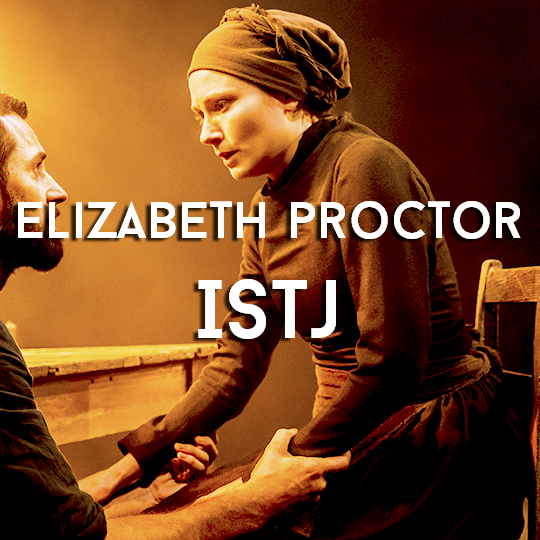
Elizabeth Proctor from The Crucible
ISTJ
by Rebecca
requested by @iifthiswereamovie

Introverted Sensing (Si)
“John, I counted myself so plain, so poorly made, no honest love could come to me! Suspicion kissed you when I did; I never knew how I should say my love. It were a cold house I kept!”
Elizabeth is doing her best to be perfect within the expectations of her community, doing many of her duties as a wife without complaint. She acts as a housekeeper and mother, avoiding the problems of the Salem witch trials until they come to her directly. She does not question the expectations set upon her, always staying within the lines. She is loyal to John and their marriage even until their final moments, finding ways to protect him and their marriage. Despite the intensity that overthrows her life, Elizabeth stays constant and moral through it all.

Extroverted Thinking (Te)
“You’ll tear it free—when you come to know that I will be your only wife, or no wife at all! She has an arrow in you yet, John Proctor, and you know it well!”
Elizabeth is deeply intelligent, able to understand situations as they arise even in the mayhem of the Salem Witch Trials. She determines, correctly, that Abigail is acting to get rid of her so that she may have John all to herself. She is able to take together all of the information in the outside world and synthesize it to come up with the correct conclusion, then acting to prevent it from coming true. She knows when to make demands of others and be stern, particularly when she needs John to stop speaking with Abigail. She is deeply intelligent and presses when she must, always searching for the correct conclusion.

Introverted Feeling (Fi)
“He have his goodness now. God forbid I take it from him!”
Elizabeth struggles with warmth, but throughout the events of The Crucible she forges an intense loyalty and love for her husband. She blames John’s adultery on herself, claiming that she was far too cold towards him and should have been more openly caring.
For much of the play she struggles with opening up about her emotions, finding difficulty in outwardly expressing her feelings She refuses to admit that her husband had an affair with Abigail, lying so she can protect his name and honor. Though this does not align with social norms, it shows that Elizabeth has a morality that is not easily swayed by the mania and falseness of the outside world.

Extroverted Intuition (Ne)
“There be a thousand names; why does she call mine? There be a certain danger in calling such a name—I am no Goody Good that sleeps in ditches, nor Osburn, drunk and half-witted. She’d dare not call out such a farmer’s wife but there be monstrous profit in it.”
The chaos that overtakes Salem with the beginning of the witch trials repels Elizabeth, who prefers to stay in control. When she is named in the witch trials, she points out that she has no good reason to be called a witch due to her usual proper behavior. She, unlike some of the women in Salem, never goes outside the lines of what is expected of her – except for when she lies to protect John. It isn’t until Mary Warren gives her the poppet that she becomes truly intertwined with the witch trials, as she had been waiting by the side up until that point. She would’ve been content to keep her simple and quiet life, but her husband’s affair made chaos unavoidable.


Support us on Patreon and Ko-Fi!

image

Tewfiq from The Band’s Visit
ISTJ
by Rebecca
requested by anonymous

Introverted Sensing (Si)
“It’s the sound of water, and waves…distant children playing on the beach…and the sound of the bait, falling in the water. In the early hours, on the sea, you can hear the whole world like…like symphony.”
Tewfiq, through his many experiences in the world, has developed habits and structure that allow him to carry through life in spite of negative feelings underneath. He has led his band well, developing its reputation through specific ways of working and acting that he enforces. He is very clear about what he does and does not want from his band, and is not afraid to take action to make sure everyone stays in line…especially Haled. He has an intense connection with music and the experience of conducting, finding beauty within the sensation. He is generally reserved, saying only what he feels is necessary to get his point across.

Extroverted Thinking (Te)
“We are here to represent our country, and as always we will do so with the highest standard of both musicianship and professionalism.”
Tewfiq knows how to take charge of a situation as well as when to back off, preferring structure and order to any sense of chaos. He functions as a strict leader of the band, making sure to keep his authority clear alongside his professionalism. He makes this very clear when instructing the band of what to do at the beginning of the show, acting with precision and authority. No matter what happens, he tries to remain professional and pragmatic, including when the band ends up in the wrong city. He moves immediately towards leaving and taking the necessary steps to prevent any issues in the future, and it is only the need for food that leads him to stay.

Introverted Feeling (Fi)
“Itgara’a. Itgarahoum. Inta el wihda. Inta el farah. Itgarahoum.”
Tewfiq tends to keep his deeper feelings to himself, but finds moments to share what he feels whether through music or discussion. He opens up about his emotions to Dina, specifically when it comes to his experience of music and his personal life. With her he is able to talk about beauty and love, moving past his facade of a strict, intense band leader. Even when speaking of the tragedy of his family, he remains fairly steady – he feels the emotions deeply but doesn’t necessarily display them intensely. His inner emotional state is always present, even if it is not readily apparent to those around him.

Extroverted Intuition (Ne)
“I was hard with him. I didn’t understand. He was gentle, and fragile…like her. I…I didn’t understand him.”
Tewfiq is adverse to chaos and things not going to plan, and prefers not to create any kind of trouble in his surroundings. When he opens up to Dina about his wife and son, he shows that he struggles with handling things that don’t fit into his prior understanding. He feels guilt over what happened to his family, feeling that his strictness led to them falling apart. He seems somewhat overwhelmed by getting stuck in Bet Hativka, only finding comfort when he starts to connect with Dina over Arab movies and music. Tewfiq tends to stick to what he knows, although this doesn’t always turn out well for him.


Support us on Patreon and Ko-Fi!

Ernst Robel from Spring Awakening
INFJ
by Owen
requested by sidjenkins and anonymous

Introverted Intuition (Ni)
“Sometimes, when it’s quiet, in the evening like this, I imagine myself as a country pastor.”
Ernst mostly stays in his own head, imagining what his future holds to keep preoccupied from the oppressive world he lives in. When he is talking with Hanschen in the vineyard, he speaks of his idyllic ‘dream’: to live in the countryside as a pastor with a wife. However, Hanschen soon calls him out for it, revealing what Ernst truly wants. An idealist, he searches for the deeper meaning of his life when nothing seems to make sense.

Extroverted Feeling (Fe)
“Oh, no! I love you, Hanschen! As I’ve never loved anyone!”
Ernst cares a large deal about what others think of him. Carrying himself in a delicate manner, Ernst is shy and timid. He is extremely kind to everyone, even his academic rivals (such as Moritz, who fails in place of Ernst) and presumably the girls. This can best be seen in “The Word Of Your Body Reprise,” as he falls for Hanschen’s seduction and reveals that he returns Hanschen’s feelings, going as far to say that he is in love with him.

Introverted Thinking (Ti)
“God, my whole life’s just some test.”
Ernst is not very academically intelligent, as he is failing in school, but he has a great amount of depth to him. Most of his logic is filtered through his emotions first, as he is curious about how he fits in the society around him. In “The Bitch of Living,” he starts to analyze his own attraction to boys, as if life is ‘testing him.’ As he doesn’t know what is happening with him, he shows himself to be willing to learn about the more sensual things in life (Se).

Extroverted Sensing (Se)
“Touch me, just like that…”
Ernst has trouble acting within the moment, preferring to look within himself and wait for the coming times. When Hanschen kisses Ernst in “The Word of Your Body Reprise,” Ernst is initially taken aback as he thought they would only talk, but Ernst quickly takes initiative for the first time and kisses him back. Ernst frets about his burgeoning sexuality, but as his solo in “Touch Me” shows, he isn’t as frightened by what he feels as Moritz is.

Support us on Patreon and Ko-Fi!

image

Julie Jordan from Carousel
ISFP
by Rebecca
requested by anonymous
Note: This typing contains mentions of abuse.

Introverted Feeling (Fi)
“If I loved you… It wouldn’t make no difference what you’d – even if I died for it.”
Julie keeps her emotions close to her chest, but it is apparent that her feelings are always present and guiding her forward. She doesn’t tell Billy that she loves him until he is dying, keeping her emotions from him until she can’t anymore. Her feelings are deep and powerful, but she doesn’t vocalize them until Billy’s last moments. She tends to be quiet and elusive about her own feelings, causing others to note “You’re A Queer One, Julie Jordan.” Her feelings are deep and driving, but she rarely feels the need to openly share them with others.

Extroverted Sensing (Se)
“When you walk through a storm keep your chin up high and don’t be afraid…of…the…dark…”
Julie isn’t afraid to make a decision in the moment, taking a chance on something new and exciting. She decides to stay with Billy after he loses his job, even though it means risking her own. This is a decision she makes more or less on the spot, deciding to stay despite the consequences – losing her job and possibly her reputation. She has a strong physical attraction to Billy in addition to her deep love for him. Their relationship begins on a whim after he lifts her onto the carousel, and continues with an unsteady passion even as her love for him solidifies.

Introverted Intuition (Ni)
“But somehow I can see just exactly how I’d be, if I loved you…”
Julie isn’t always looking at the bigger picture, but she has moments where she can step back and look ahead. This is seen very well in the song “If I Loved You,” where she describes a clear image of how she would act if she was in love with Billy. She looks into the future and is able to see it with clarity and accuracy, especially as much of what she says comes true. She claims at the beginning of the show that she’s never going to marry anyone, but this does not turn out to be true. Julie is able to step back and see greater patterns in her life, finding Billy’s presence even after his death.

Extroverted Thinking (Te)
“Common sense may tell you that the ending will be sad, and now’s the time to break and run away. But what’s the use of wond’ring if the ending will be sad?”
Julie tends to keep to herself and avoid enforcing any change in the world, even in some of her more personal matters.
She tends not to protest whenever things don’t go her way, particularly when it comes to her relationship with Billy.
She swallows her feelings even though she feels hurt by Billy’s behavior, choosing instead to keep to herself.
She is far less bold than her cousin Nettie or her friend Carrie, preferring to find some sense of control in her own life. She is rarely abrasive or forceful, unless she feels that her inner feelings are threatened or questioned.


Support us on Patreon and Ko-Fi!

Balaga from Natasha, Pierre, and the Great Comet of 1812
ESFP
by Rebecca
requested by anonymous

Extroverted Sensing (Se)
“Risking skin and life twenty times a year, for my fine, fine gentlemen.”
If Balaga is interested in anything, it’s excitement and thrill. His business is based off his high speed troika rides, which throw caution to the wind. He does not mind the risk at all, because it gives him something exciting in his life. He has been known to get into dangerous situations “more than once,” allowing him to build up a reputation. He looks forward to when he gets to drive his troika, because it will give him excitement, alcohol, and companionship.

Introverted Feeling (Fi)
“I don’t do this for rubles, I do it cuz I like ’em!”
Balaga, though he is a risk-taker, is also loyal to his customers that he takes on his troika rides. He does his job not for money, so much as for alcohol and because he enjoys the company. He knows plenty of secrets from his customers, but keeps them to himself. His morals are guided primarily by how he chooses to experience life for the thrill of it all (Se). He does not seem overly concerned about whether what he is doing is right or wrong – he certainly doesn’t care much for the law.

Extroverted Thinking (Te)
“And the troika tore down Nikitski Boulevard!”
Balaga is able to follow the plans set for him, even though his thrill-seeking behavior might lead people to believe otherwise. He follows the plan given to him by Anatole for the elopement, taking Anatole and Dolokhov to where Natasha is. He doesn’t falter, however, even when the plan falls apart and Marya drives Anatole away. He doesn’t seem to care about thinking plans through for himself, nor taking charge. He can adapt when he must, paying attention to what is happening in front of him (Se).

Introverted Intuition (Ni)
“Who knows things that would get you sent straight to Siberia if anyone found out?”
Balaga doesn’t look ahead much, instead preferring to live in the moment and enjoy everything it can offer. He takes up the job of troika driver without thinking of the consequences, even with an elopement involved. Unlike Dolokhov, he isn’t worried about what might happens – all that he thinks about is what is in front of him. He doesn’t worry about looking deeper into the situations because it frankly does not matter to him. He carries secrets about those who take his troika rides, but is loyal enough not to release these secrets into the world where they could lead to trouble (Fi).


Support us on Patreon and Ko-Fi!