Fastrada from Pippin ENFJ by Rebecca requested by anonymous
Extroverted Feeling (Fe) “God’s wisdom teaches me when I help others, I’m really helping myself!”
Fastrada is successful in manipulation particularly because she is able to present herself in certain ways and charm others. She is bubbly and flirtatious, used as a front as she slides in ideas and thoughts that help to bring Louis to the throne. Her solo song, “Spread A Little Sunshine,” is focused around “helping” others – or, rather, acting kind to others in order to exploit them. Under the guise of aiding Pippin and Charlemagne, she is really placing them up against one another. She seems to enjoy attention as well, whether from the men in her life or from the audience.
Introverted Intuition (Ni) “I’d rather be drawn and quartered than think I was in any way responsible for what happened next.”
Fastrada is looking ahead – she has her goals, so she seeks them in whatever way she can. Her main goal is to make Louis the king, and she knows that whether Pippin kills Charlemagne or the other way around, there is a path. Since she is constantly looking ahead to this one goal, she is able to find the steps to reach it. Her ability to understand others, bolstered by her Fe, is what allows her to manipulate them so effectively. She knows more or less what will happen next as she hides her true goals under the surface, letting her plan come more or less to fruition.
Extroverted Sensing (Se) “Despite this rejection, I took upon my tiny shoulders the task of affecting a rapprochement between two men for whom I felt deeply.”
Fastrada is far from unaware of her good looks and appeal, and she uses it alongside her Fe to get what she wants. It is mentioned that a great deal of Fastrada’s influence over Charlemagne is their sexual relationship. She tends to buy many expensive things, to the point that she is spending more money than she actually has. She lusts after power, though in an indirect manner – her desire to put her son on the throne will allow her even greater influence than she already has. She tends to see most of the people in her life as disposable, as she sticks with Charlemagne primarily for his power and seems to have no real affection for Pippin.
Introverted Thinking (Ti) “I’m just an ordinary housewife and mother, just like all you housewives and mothers out there.”
One aspect of Fastrada’s plans is that she always requires others to get things done, rarely taking direct control herself. She seems much more content with keeping her plans close and pulling the strings. She seems comfortable with manipulating other people’s emotions rather than acting as a logical advisor. Her plans for putting Louis on the throne rely mostly on the growing emotional tensions between Pippin and Charlemagne. She doesn’t care much who is around her as long as she isn’t alone.
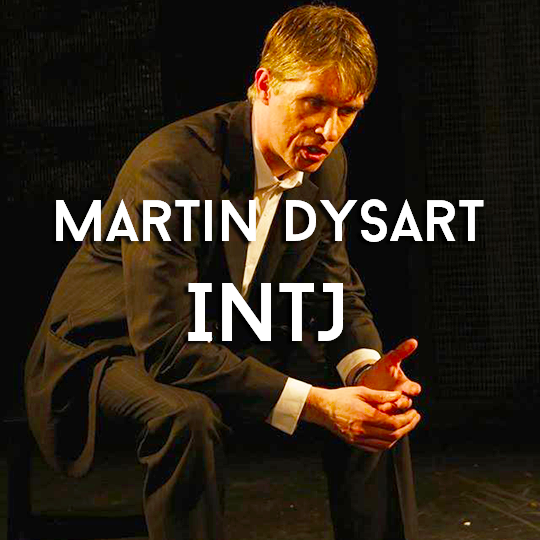
Introverted Intuition (Ni) “Moments snap together like magnets, forging a chain of shackles…why at the start they were ever magnetized at all…I don’t know…then what am I doing here? I don’t mean clinically doing or socially doing – I mean fundamentally!”
Dysart is remarkably perceptive, demonstrating his ability to draw surprisingly accurate conclusions from little evidence. His ability to see beyond the surface of the children that he works with allows him to work with patients that most people couldn’t dream of. He uses methods of psychoanalysis in his work, which is focused on drawing out the unconscious and feelings from deep within one’s psyche. He deals quite a bit with symbolism, understanding himself like a horse or a Grecian priest. As he continues to work with Alan Strang, he starts to question his place in the world more and more, taking a deep look at his own existence.
Extroverted Thinking (Te) “Essentially I cannot know what I do – yet I do essential things. Irreversible, terminal things. I stand in the dark with a pick in my hand, striking at heads!”
Dysart, in his exterior life, is not an emotional person – he tends to stick to thoughts and facts, especially within his job. He is heavily involved with understanding the world around himself, as well as his own inner life through Ni. There are several moments when he is talking to Hesther about himself and his life as if he is outside of it and looking in to analyze it. He forms a fact-based understanding of the world, a structure that he then forms his own understanding of through Ni and Fi. He is able to maintain a level of emotional distance from his patients in order to stick to the facts of the situation – that is, until he starts to feel guilty and jealous when treating Alan.
Introverted Feeling (Fi) “The Normal is the good smile in a child’s eyes – all right. It is also the dead stare in a million adults. It both sustains and kills – like a God.”
Dysart speaks about his feelings to few people, and when he does it often comes off as self-analytical rather than emotional. There are moments where his emotions do emerge, but they tend to be explosive, as he externalizes deep inner turmoil. Dysart shows his struggles with the morality of his work, specifically in how “fixing” children to be “normal” may not be a benefit. This manifests most vividly in his dream where he is sacrificing children and it makes him ill. His views start to seriously conflict with the surrounding world, but he feels powerless to express his inner feelings and thoughts as he has no one to listen.
Extroverted Sensing (Se) “I’m jealous, Hesther. Jealous of Alan Strang.”
Dysart craves passion in his life, but he has suppressed so much of his more primal connections to the world that he feels he cannot reach it. He lives in a loveless and sexless relationship with his wife, and struggles to find true connections with others. His tendency to find deeper meanings with Ni end up leading him to faulty conclusions about details in the moment, such as how he thinks Alan’s stare is accusing him. In the moments where Dysart decides to look at his life as it truly is in that moment, he finds himself disgusted by who he has become and what he is doing. He desperately wants to give in to his desires, but finds that he is stuck in a life utterly devoid of acceptable outlets for such things.
Anne and Peter are the two youths in the Annex, who go from clashing with one another to a romantic relationship. At first, it seems that their differences are too much for either of them to bear – something that is reflected in their different MBTI types. But with a closer look, it becomes clear how the two can complement one another in their ways of approaching the world. Anne can help bring Peter out of his shell, while Peter can help ground Anne.
Anne’s dominant function is extroverted intuition (Ne), while Peter has tertiary introverted intuition (Ni). Anne’s strong Ne allows her to approach situations with a great deal of creativity and openness, but also can make her appear overly rambunctious in a way that initially irritates Peter. Peter, on the other hand, seems rather caught up within his own mind, finding difficulty in looking towards the future. Anne’s approach to life, searching for opportunity, allows her to help Peter see beyond the Annex and understand the possibilities of the world changing for the better.
Another major difference comes in the forms of their thinking functions: Peter’s dominant introverted thinking (Ti) and Anne’s tertiary extroverted thinking (Te). Peter demonstrates that he often wants to be alone and separate from the others, including the always thinking out loud Anne. Anne, while not as successful as her sister Margot, is stronger in schoolwork than Peter, who prefers to stick to his own logic. But each of them know how to think for themselves – it is when they share those thoughts that they grow closer.
Some of their defining traits come through their respective feeling functions – Anne’s auxiliary introverted feeling (Fi) and Peter’s inferior extroverted feeling (Fe). Peter is highly introverted, tending to avoid social contact until he develops a close, personal relationship with Anne. Anne, on the other hand, carries herself with strong ideas about life, morality – many of which she keeps to herself and her diary. Anne is vital to helping Peter create a social bond, while Anne’s growing trust for Peter allows her to open up and share her perspective.
The final difference between Anne and Peter – and the final way they are able to find a connection that helps them to improve themselves – is through their sensing functions. Peter has auxiliary extroverted sensing (Se), and Anne inferior introverted sensing (Si). Anne shows a certain kind of nostalgia for the times outside the Annex, for her friends and the happy life she used to have. Peter helps her to see the current moment, as he more easily lives in the present. But he also wants the world to change immediately, and Anne must show him how the world has always changed, gone through “phases.” With no functions in common, Peter and Anne are intensely different – but their differences are the key that helps them to grow closer to one another and improve themselves i the process.
Otto Frank from The Diary of Anne Frank INTJ by Rebecca requested by
Introverted Intuition (Ni) “But always remember this, Anneke. There are no walls, there are no bolts, no locks that anyone can put on your mind.”
Otto is constantly doing his best to look beyond – whether beyond the present to the future, or outside of the Annex. He tries to remain optimistic and hopeful even when it seems things are falling apart, and tries to spread this way of thinking with others. He is able to look beyond people’s immediate words and expressions to figure out what they are really feeling and how best to talk to them. This sensitivity to what happens underneath helps him to become a trustworthy leader in the Annex. His ability to be aware of what is going on beneath the surface and in the long term helps him to avoid falling apart completely throughout his struggles.
Extroverted Thinking (Te) “ What about it, Peter? Shall we make our school coeducational?”
Otto is almost always level-headed, easily falling into a position of leadership both in his job prior to the Annex and in the Annex itself. He is known for his high level of education and his ability in leading a business prior to arriving at the Annex. He shows a desire for knowledge and understanding, whether through reading books or through wanting to fully grasp a dangerous situation. He finds logical solutions as often as possible, avoiding getting overwhelmed in his pursuit of order and peace in the Annex. But finds that there are not always logical solutions to things, and whatever structure he may provide may not be enough.
Introverted Feeling (Fi) “She puts me to shame.”
Otto is constantly striving to do what is right, aligned with his mature and clear moral compass. He does his best to instill values in his children, something in which he is quite successful. In particular, after reading through his daughter’s diary, he feels that he cannot match Anne’s inherent goodness and ability to see good in the world. He tends to be levelheaded and at ease with his emotions without becoming aloof, shown particularly well through his sense of humor. Generally, he does not become emotionally overwhelmed in the outward manner of most of the other people in the Annex, so when his emotions do flood out, it becomes clear something is very wrong.
Extroverted Sensing (Se) “ I can’t stay in Amsterdam, Miep. It has too many memories for me. Everywhere there’s something…the house we lived in…the school…that street organ playing out there…”
Otto is more of a planner than an improviser, though he can do the latter if it is necessary. The moments of greatest chaos and highest emotions are the ones where Otto breaks, unable to find a proper solution. He is more of a natural peace-keeper, disliking the moments of overwhelm that sometimes occur in the high-stress environment of the Annex. But when Otto cannot look past the present moment with his Ni, he struggles the most. This is seen after the Annex, when the sensory details of his trauma end up haunting him, leading him to feel that he must leave Amsterdam behind.
Introverted Feeling (Fi) “I can’t regret what I did for love.” Diana’s own values serve as a clear guide for her actions. Instead of being affected by external opinions, she chooses to follow her dreams, no matter what others might think; for instance, despite her old acting teacher and classmates’ harsh criticism, she has persisted in becoming an actress. Diana also deeply understands the values she shares with the rest of the auditioning dancers, and she uses her experiences to reflect upon her ideals; this is shown in “What I Did For Love,” where she rallies the other dancers behind their mutual love for performing and the possibility of failure, using Paul’s injury as an opportunity for the rest of the dancers to reflect upon their lives and their goals.
Extraverted Intuition (Ne) “Kiss today goodbye, and point me toward tomorrow.” Diana has no qualms looking ahead. After Paul’s injury, while the other auditioners lament the glory days that have past and the uncertainty of their profession, Diana instead states that although she knows she can never be sure she’ll get work, she’ll keep trying even though “it’s just something you’re gonna have to wait and see.” It’s clear she has always set her sights towards the future; when Zach asks what she did growing up, she responds simply, “In the Bronx? Mostly wait to get out.”
Introverted Sensing (Si) “It’s the first day of acting class, and we’re in the auditorium, and the teacher, Mr. Karp… oh, Mr. Karp… Anyway, he puts us onstage with our legs around each other, one in back of the other, and he says, ‘Okay, we’re gonna do improvisations. Now, you’re on a bobsled. It’s snowing out, and it’s cold. Okay, go.’” Though she looks toward the future with ease, Diana’s memories are vivid and specific. Rather than vaguely remembering how she felt in her high school acting class, for instance, she describes the exact circumstances and then how they made her feel. She has a strong connection with her past and recognizes how it has shaped her, remembering how she used to see chorus girls coming out of the stage door “with their eyelashes and their makeup” and would dream of being like them.
Extraverted Thinking (Te) “Nobody got into this business to play it safe.” Although she is aware of objective truths, Diana disregards them in favor of her dreams. When faced with something she doesn’t understand, she tends to overthink the problem, and she struggles to adapt to learning styles unlike her own, like she describes in “Nothing.” She also becomes frustrated when others don’t see a situation the way she does (“We’re all here because we wanted to be here and you’re all acting like it’s just another job – and it’s not. So, what are you all talking about?”), and when stressed, she tries to solve problems with ineffective logic, for instance, giving herself a time limit to succeed on Broadway – a time limit that she has now rejected, having learned this was a mistake, instead still trying to succeed because she knows it’s what makes her happy (FiNe).
Connor Murphy from Dear Evan Hansen ISTP by Rebecca requested by anonymous Note: Suicide and mental illness mentioned.
Introverted Thinking (Ti) “But, if somehow you can keep them thinking of me…”
Connor is always making his own conclusions, approaching the world with his own mind. He lives very much in his own head and the conclusions he has made there, not trying to shift others or interact with them. He sees no need to rely on others in most of his life – he demonstrates a belief that he only needs himself. He appears rather enigmatic and distant from the others at his high school, keeping his own thoughts to himself. Because he focuses so strongly on his own inner sense of logic, he tends to misinterpret situations and go solely with his gut reaction, which becomes even more of a narrow view when combined with his tertiary Ni.
Extroverted Sensing (Se) “No one’s signed your cast.”
Connor doesn’t wait to act once he believes he knows what is going on, and he doesn’t hold back. When he gets upset, he tends to react in physical ways, often threatening or using violence to get out his emotions. An example of this is when he pushes Evan over, overwhelmed by the idea of people laughing at him. He uses drugs to the point where he is going to school while high, a signal of substance abuse. He easily notices details about the external world and finds ways to react to them, whether or not he seems to care about the consequences of these actions.
Introverted Intuition (Ni) “You wrote this because you knew that I would find it.”
Connor has trouble seeing a future for himself, and when he looks deeper into situations he often ends up going astray. Perhaps the biggest example of this is when he sees the letter Evan wrote mentioning Zoe and believes Evan wrote the letter so that he would see it and freak out. He jumps to an immediate conclusion, becoming fixated on this one idea and refusing to see beyond his gut reaction. He also is shortsighted when it comes to his own future, which is likely a factor in him taking his own life. His Ni is used in a very unhealthy manner, used to help support faulty Ti conclusions and give him an excuse to act dangerously in his life.
Extroverted Feeling (Fe) “You think I’m the freak?”
Connor is a loner who appears to have no friends and few social connections, tied to a lack of social ability. He generally doesn’t seem able to reach out to others and form some kind of friendship, instead often scaring people away. Typically, when he shows emotion, it is only anger and aggression spilling out all at once. But underneath, there is clearly a longing for some kind of a connection, as seen in the genuine moment where he ends up signing Evan’s cast. In spite of Connor constantly appearing alone, it seems that on some level he wants to be understood and accepted by the greater public, pushing against the idea of being a “freak” and trying to form some kind of connection with Evan.
Note: Mentions of sexual assault, murder, and antisemitism.
Leo Frank is the protagonist of the musical Parade, and an INTJ. He is one of relatively few fictional INTJs that don’t fall into the role of villain or mastermind. These traditional INTJ roles are the results of stereotypes – INTJs can only be cold and detached, can only be planners focused on logic, and so on. But Leo Frank helps to fight back against these stereotypes as a sympathetic and good character in the twisted world featured in Parade.
Perhaps the most common stereotype about INTJs is that they are only attuned to logic and tend to be detached. In his own way, Leo is detached – likely an effect of his dominant introverted intuition (Ni) and inferior extroverted sensing (Se). He cannot find a way to adapt to the world of the south, and instead throws himself into his work and his own mind. But he is not callous and emotionless – far from it. He is quiet and shy rather than stuck up in his own thoughts. He shows genuine concern over the death of Mary Phagan, and then goes on to demonstrate his despair at getting branded a murderer and his growing affection for his wife, Lucille.
But the stereotypes of INTJs do not escape Leo – they are part of what get him into a great deal of trouble as he is blamed for the rape and murder of Mary Phagan. He is painted as a manipulator who uses his intellect through auxiliary extroverted thinking (Te) to lure young girls up to his office in order to have sexual contact with them (Se). His quiet and distant nature, formed by dominant Ni and tertiary introverted feeling (Fi) makes it easy for people to project an image onto him. Combine this with his presence as a Jewish man from the north, and he quickly becomes a monster in the eyes of the Southerners.
In spite of all these ways that Leo’s own personality and identity is twisted against him, the audience is able to see another side to him. He is clearly a protagonist, which is a welcome change from many other INTJ characters. His shyness and distance help the audience to empathize with him, and realize just how corrupted those features become in the accusations of the press and public. He is not conniving in any way – he is simply trying to live his life as he ends up surrounded by hatred.
Leo Frank does not get a happy ending. He, like INTJs in general, is made out to be a villain that he clearly is not. But his journey, his presence as a protagonist, shows hope that perhaps INTJs may not always be the villain after all.
Extroverted Thinking (Te) “Either you’re closing your eyes to a situation you do not wish to acknowledge, or you are not aware of the calibre of disaster indicated by the presence of a pool table in your community.” Harold is logical and intelligent, keeping a strong hold on his cons even when they seem to spiral into chaos: which he doesn’t always see as a liability. He is a successful con man, moving from town to town under the doctorate “Professor” and selling them boys bands to take their money. He takes no time in deceiving the townspeople of River City, immediately convincing them that they have “Trouble” on their hands with the addition of a pool table. He has a bold, leadership-like personality that commands everyone’s attention and slowly charms them.
Introverted Sensing (Si) “The same old way.” Harold’s method of conning is the same as he has always done: selling boys bands to small towns. The method has worked for him the past multiple times, so he sticks to it when he comes to River City. Like Marian, Harold states his longing for an established woman to eventually make a home with to Marcellus in “The Sadder But Wiser Girl”. Sometimes, however, Harold doesn’t pay attention to the small details in his schemes, such as when Marian tells him that Gary Conservatory – the school Harold claims to have graduated from – wasn’t around at that time.
Extroverted Intuition (Ne) “I prefer to take a chance on a more adult romance.” Harold plans on using the same old scheme (Si) to deceive River City, but he shows that he enjoys the various ideas and opportunities he shows them. His songs, such as “Trouble” or “Seventy Six Trombones” are very wordy, changing topics and sentences at the drop of a hat. He uses his quick thinking to avoid the school board’s questioning, as well as when he convinces Marian of his authority of the think system. Harold carries with him a sense of curiosity and defiance with him, which turns out to be exactly what Marian and the other townspeople need.
Introverted Feeling (Fi) “A girl who trades on all that purity merely wants to trade my independence for her security.” Harold’s emotions aren’t shown much, as he employs his commanding and emphatic personality much of the time (Te). However, he does care about the citizens of River City deep down, such as when he comforts Winthrop after it is revealed that he is a con man. His beliefs about women are hard to change (“The Sadder But Wiser Girl”), but he eventually realizes that he is truly in love with Marian and ready to settle down with her. Harold is stubborn and often seems to not truly care for the feelings of others, such as when he follows Marian home, but he has a large heart underneath.
The two lead characters of Hello, Dolly! are quite the odd couple – and yet it is their quirks and complexities that end up leading them together by the end of the show. Their four letter types share all but one letter, but within their functions are a great deal of differences that help to shape their places in the world and their places with one another. Though, these similarities are not to be overlooked – they say much about how the two connect in spite of their disagreements.
While both Dolly and Horace have dominant judging functions, they are very distinct. Dolly has dominant extroverted feeling (Fe) and Vandergelder has dominant extroverted thinking (Te). This is clear in their most basic interactions with the world – Dolly is a people person who enjoys her place in other people’s lives, whereas Vandergelder functions as a leader of a business who focuses on efficiency and intellect. They both understand and are able to affect structures, however one is far more connected to emotions while the other is more about intellect. From this primary difference they often have trouble seeing eye to eye – to Vandergelder, Dolly’s decisions are perplexing because they come out of an understanding of how people’s feelings work rather than what makes the most logical sense in a given situation. They struggle to understand each other in this way, but this conflict also brings interest.
With nearly opposite dominant and inferior functions, Vandergelder and Dolly interestingly share auxiliary and tertiary functions. In particular, they both use Si as their auxiliary function. They tend to orient themselves towards the past and what has worked then in order to guide themselves forward. Vandergelder discusses how a “penny in his pocket” grew into a fortune, while Dolly focuses on her life with Ephraim. These elements are tied to their dominant functions, which are distinct, but also provide a connection. Even if they do not realize just how similar they are in this regard, this element of their personalities is important to guiding them together.
Just as they share auxiliary Si, Vandergelder and Dolly both have extroverted intuition (Ne) as their tertiary function. Despite their connections to the past, each of them are able to understand how making new and different choices can help guide them forward. While Dolly seems more able to withstand chaos – she’s often the causing it, after all – their decisions to take a chance on something and someone new are what lead to their marriage at the end of the show. Vandergelder realizes a life without Dolly is a possibility he does not want to pursue, and Dolly realizes she cannot keep herself stuck in the past and must join life once again.
For their inferior functions, Dolly has introverted thinking (Ti) and Vandergelder has introverted feeling (Fi). Just like their dominant functions, these are very distinct and form many of their misunderstandings. Dolly is highly intelligent and able to analyze situations, but she relies heavily on her emotional intelligence and personal understandings – which is something Vandergelder simply does not understand with his dealings in efficiency and objectivity. Vandergelder has his own weaknesses, particularly with emotions – he is stubborn in his beliefs, and can seem quite callous to others. This draws a deep contrast to Dolly, who cares immensely and people and helping them in her own way. But for all of their conflicts, it’s clear how these not-quite-opposites attract.
Lola from Kinky Boots ESFP by Rebecca requested by anonymous
Extroverted Sensing (Se) “No need to be embarrassed. I like being looked at, and you like to look.”
Lola’s focus centers around her appearance and her presence, allowing her to remain in charge of the moment no matter where she goes. She puts a great of effort into her appearance, whether or not she is wearing drag. In addition, she often discusses elements of a sexual nature, such as in “The Sex is in the Heel.” She demonstrates physical ability with her experience in boxing, as she is able to hold her own against Don in the ring. But, above all, Lola is able to captivate and seize the world around her, both as a performer and as a person.
Introverted Feeling (Fi) “Hold me in your heart till you understand. Hold me in your heart just the way that I am.”
It might seem easy to write Lola off for appearing shallow, but she reveals a great deal of depth and confidence within her own identity. One of her primary goals in life is to get her father to understand her personality and way of life. Despite pressures to change and be “a man,” Lola consistently stays true to herself and every quirk that comes along with her personality. She is loyal and fights for what she believes in, teaching those around her lessons about understanding others and sticking to a goal. She presses people to embrace themselves just as she has embraced herself, and leads everyone from Charlie to Don through her dedication.
Extroverted Thinking (Te) “Look at me powerless and holding my breath, trying hard to repress what scared him to death.”
Lola’s tendency towards emotions and understanding sometimes diverts her from more logical ways of looking at things, but she is more than capable of planning and thoughtfulness. More often than not, Lola’s tertiary Te manifests itself in a feeling of a lack of control. As confident as she is and as much of a presence as she has, she finds that in many areas of life she is unable to exert control, such as in the situation with her father. In many ways, however, she is a leader – for instance, she takes charge of the way the boots look in the factory. This element, of course, stems from strength in her own identity, an element of her Fi.
Introverted Intuition (Ni) “When I lost my way, you were there to see me through. Now let Lola lend some love and do the same for you!”
Since she was young, Lola fixated on performing and becoming someone glamorous and fascinating, to the point she never separated from it. The path she started on when she was young led her to drag, and she has stuck with it. She focuses less on specifics in the future because she is more interested in the details of the moment. Lola tends to struggle somewhat when the plans she does make are twisted, such as when Charlie disagrees with her decision to use the angels as models. She is often aware of the consequences of what she does, but that does not mean she hesitates in spur of the moment action.



 Theatre MBTI