image

Anne Frank (ENFP) and Peter Van Daan (ISTP) from The Diary of Anne Frank

by Rebecca

ENFP: Ne Fi Te Si

ISTP: Ti Se Ni Fe

Anne and Peter are the two youths in the Annex, who go from clashing with one another to a romantic relationship. At first, it seems that their differences are too much for either of them to bear – something that is reflected in their different MBTI types. But with a closer look, it becomes clear how the two can complement one another in their ways of approaching the world. Anne can help bring Peter out of his shell, while Peter can help ground Anne.

Anne’s dominant function is extroverted intuition (Ne), while Peter has tertiary introverted intuition (Ni). Anne’s strong Ne allows her to approach situations with a great deal of creativity and openness, but also can make her appear overly rambunctious in a way that initially irritates Peter. Peter, on the other hand, seems rather caught up within his own mind, finding difficulty in looking towards the future. Anne’s approach to life, searching for opportunity, allows her to help Peter see beyond the Annex and understand the possibilities of the world changing for the better.

Another major difference comes in the forms of their thinking functions: Peter’s dominant introverted thinking (Ti) and Anne’s tertiary extroverted thinking (Te). Peter demonstrates that he often wants to be alone and separate from the others, including the always thinking out loud Anne. Anne, while not as successful as her sister Margot, is stronger in schoolwork than Peter, who prefers to stick to his own logic. But each of them know how to think for themselves – it is when they share those thoughts that they grow closer.

Some of their defining traits come through their respective feeling functions – Anne’s auxiliary introverted feeling (Fi) and Peter’s inferior extroverted feeling (Fe). Peter is highly introverted, tending to avoid social contact until he develops a close, personal relationship with Anne. Anne, on the other hand, carries herself with strong ideas about life, morality – many of which she keeps to herself and her diary. Anne is vital to helping Peter create a social bond, while Anne’s growing trust for Peter allows her to open up and share her perspective.

The final difference between Anne and Peter – and the final way they are able to find a connection that helps them to improve themselves – is through their sensing functions. Peter has auxiliary extroverted sensing (Se), and Anne inferior introverted sensing (Si). Anne shows a certain kind of nostalgia for the times outside the Annex, for her friends and the happy life she used to have. Peter helps her to see the current moment, as he more easily lives in the present. But he also wants the world to change immediately, and Anne must show him how the world has always changed, gone through “phases.” With no functions in common, Peter and Anne are intensely different – but their differences are the key that helps them to grow closer to one another and improve themselves i the process.

Support us on Patreon and Ko-Fi!

I personally think Peter Van Daan from The Diary of Anne Frank is an ISFP instead of ISTP. What makes you think there’s no Fi/Te in him?

Hello!

I can see where you’re coming from with ISFP, but my typing of ISTP comes more from me seeing Ti/Fe rather than not seeing Fi/Te. 

Throughout the show (I’m basing my typing off of the Goodrich/Hackett play) we see that Peter struggles with his schoolwork – which can be explained by inferior Te, but also makes sense with dominant Ti. It’s clear that he has intelligence, but uses his own systems of thought that don’t quite align with the work he does in the Annex. 

I think the stronger distinction, however, is that between Fi and Fe. Anne is clearly an Fi user – she wants to fight for her morals and has a strong sense of self. In my opinion, Peter is not like this – he caves into himself and avoids social contact, which can be explained with inferior Fe. He doesn’t have faith or a major belief system like Anne does, instead taking a more logical lens toward the world – more like Ti than Fi. I think specifically of the conversation between Anne and Peter toward the end of the show, where Peter wants to see immediate change and doesn’t care about the larger picture. This is clearly Se/Ni, but also fits better for an ST than an SF.

I think what really led me to typing Peter as an ISTP is his extreme awkwardness and distaste of social interaction. It was so strong that it seemed like he had to be inferior Fe in my mind.

But of course, at the end of the day this is all my opinion! Nothing on Theatre MBTI is definitive, because every character can be interpreted and played differently – they’re never a complete person, because they’re formed out of words in a script and notes in a score. I personally see Peter as an ISTP from my experience with the play – but that’s just me.

Thank you so much for your question – I hope this answered it!

– Rebecca

image

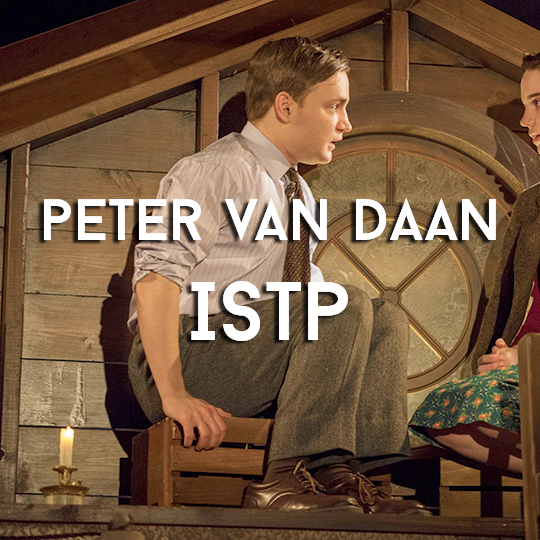
Peter Van Daan from The Diary of Anne Frank
ISTP
by Rebecca
Note: This typing is based off of the dramatization by Frances Goodrich and Albert Hackett.

Introverted Thinking (Ti)
“All right. All right. I’m a dunce. I’m a hopeless case. Why do I go on?”

There is no doubt that Peter is highly independent, and this manifests in his ways of thinking as well as his behavior in the Annex. He has his own way of thinking about the world, which makes it difficult for him to adapt to studying and performing well in academics. This also causes him to reject religion, as when Anne wishes he had some sort of religion he claims that it is not for him. He distances himself from the others in the Annex, including his own parents and the children his age. Even when he and Anne begin to bond, he continues keeping mainly to himself, only then letting Anne in as well.

Extroverted Sensing (Se)
“…all I could think is…I wanted to hit him. I wanted to give such a…a…that he’d…”
When faced with problems, Peter tends to lean towards options that are fast and physical, giving a tangible result in a minimal amount of time. He builds up negativity towards Mr. Dussel, and at one claims that he wanted to hit the old man. Towards the end of the play, Anne attempts to get Peter to see the big picture and how things will improve in the long run, but Peter rejects this and claims he wants to see an immediate end to the conflict. Both of these examples clearly show Peter’s tendency to move towards engaging in the moment to see it through. However, Peter rarely acts on these thoughts – they tend to stay filtered within his head, as he avoids messing anything up further.

Introverted Intuition (Ni)
“Look at us, hiding out for two years. Not able to move! Caught here like…waiting for them to come and get us…and all for what?”
While he may be desperate for it to come sooner, Peter is able to look into the coming days and form an idea of what will happen next. He seems to accept the fact that the families are stuck in the Annex until they are caught, a pessimistic but unfortunately realistic point of view. He also displays an ability to look at people on a deeper level – however, this element takes time. This is shown when he begins to realize that Anne has far more depth than he initially gave her credit for, leading to them developing a close relationship. As a whole, Peter’s Ni tends to take a long time to fully come into play, or it leads to pessimistic thoughts.

Extroverted Feeling (Fe)
“Please! I’m not…anyway…let me alone, will you?”
Peter spends very little of his time interacting with the other inhabitants of the Annex – social interaction seems to repel him and send him straight back into his room with Mouschi. Aside from some antics with Anne towards the beginning of the show and a few moments that have to be diffused, Peter avoids conflict with other people. Usually, he prefers the company of his cat to anyone else in the Annex – including his overbearing parents. This manifests in awkward and uncomfortable behavior whenever he is forced to interact with others. However, he also reveals he has a strong connection with his family and later Anne, formed through an emotional bond built over time.