Alan Strang from Equus
INFJ
by Rebecca
requested by @partlycloudyday

Introverted Intuition (Ni)
“I wish I was a cowboy. They’re free. They just swing up and then it’s miles of grass…”
Alan demonstrates a complicated but intense inner world that causes his to develop a religion toward horses and break out into violence. Throughout the play, the sources of Alan’s religion become clear, stemming from certain and definitive sources. Though unusual and unique to Alan himself, the development of his horse worship comes from riding a horse when he was young and stories from his mother. Alan’s religion is full and complex, with its own internal rules and concepts that he accepts fully. His inner self is so disconnected from the rest of the world that it becomes something completely its own.

Extroverted Feeling (Fe)
“She did it! Not me. It was he idea, the whole thing!…She got me into it!”
Though Alan is undoubtedly unique, he forms understandings of the world through the thoughts and actions of other people. Much of what Alan says and does can be traced back to the complicated relationship of his parents. With a highly religious mother and an atheist father, the strain over religion has characterized his life for some time and materializes in creation of his own religion for Equus. He is attracted to Jill, and ends up giving in to what she wants much of the time, wanting her reciprocated affection. Despite his unusual tendencies that separate him from the rest of the world, he is still highly affected by others, with their own thoughts and desires.

Introverted Thinking (Ti)
“Who said ‘Religion is the opium of the people’?”
Alan is remarkably observant, to the point he is quickly and easily able to make conclusions for himself. He quickly ascertains the patterns in the mental hospital, in particular realizing that Dysart is missing passion in his life. Though he cannot figure out everything, Alan is able to push Dysart to reveal much of his own problems and sometimes avoid telling his own truths. His inner world (Ni) has its own internal structure, with consistent rules that all connect within Alan’s mind. To outside observer’s, Alan’s actions do not make sense – but Dysart getting inside his mind makes his internal thoughts clear.

Extroverted Sensing (Se)
“I couldn’t take my eyes off them. Just to watch their skins. The way their necks twist, and sweat shines in the folds…”
Many of Alan’s problems stem from his difficulty interacting with the physical world, particularly with confused messages about sexuality. His obsession with horses, alongside its highly spiritual component, is also highly sexualized and focused on the sensual experience of riding a horse. When he discusses horses, he talks about the sensual, immediate aspects of it first, and then these lead him to a more general reverence (Ni). However, he also seems to be frustrated with the superficiality of modern society, from their focus on brands to all kinds of men seeing a pornographic film. He seeks something more raw and real, which is what he finds within his personal religion toward horses.

Support us on Patreon and Ko-Fi!

image

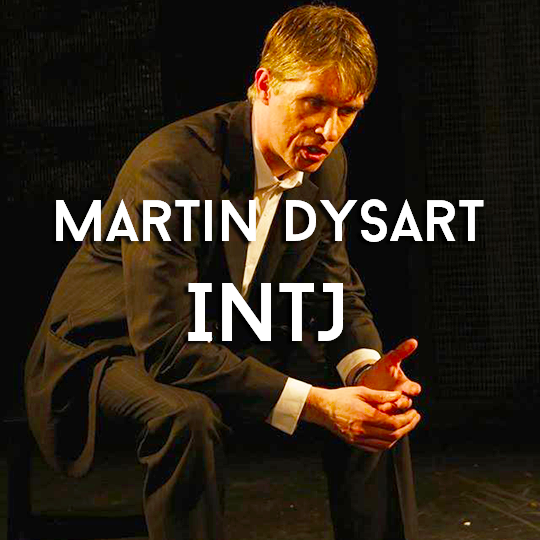
Martin Dysart from Equus
INTJ
by Rebecca

Introverted Intuition (Ni)
“Moments snap together like magnets, forging a chain of shackles…why at the start they were ever magnetized at all…I don’t know…then what am I doing here? I don’t mean clinically doing or socially doing – I mean fundamentally!”
Dysart is remarkably perceptive, demonstrating his ability to draw surprisingly accurate conclusions from little evidence. His ability to see beyond the surface of the children that he works with allows him to work with patients that most people couldn’t dream of. He uses methods of psychoanalysis in his work, which is focused on drawing out the unconscious and feelings from deep within one’s psyche. He deals quite a bit with symbolism, understanding himself like a horse or a Grecian priest. As he continues to work with Alan Strang, he starts to question his place in the world more and more, taking a deep look at his own existence.

Extroverted Thinking (Te)
“Essentially I cannot know what I do – yet I do essential things. Irreversible, terminal things. I stand in the dark with a pick in my hand, striking at heads!”
Dysart, in his exterior life, is not an emotional person – he tends to stick to thoughts and facts, especially within his job. He is heavily involved with understanding the world around himself, as well as his own inner life through Ni. There are several moments when he is talking to Hesther about himself and his life as if he is outside of it and looking in to analyze it. He forms a fact-based understanding of the world, a structure that he then forms his own understanding of through Ni and Fi. He is able to maintain a level of emotional distance from his patients in order to stick to the facts of the situation – that is, until he starts to feel guilty and jealous when treating Alan.

Introverted Feeling (Fi)
“The Normal is the good smile in a child’s eyes – all right. It is also the dead stare in a million adults. It both sustains and kills – like a God.”

Dysart speaks about his feelings to few people, and when he does it often comes off as self-analytical rather than emotional. There are moments where his emotions do emerge, but they tend to be explosive, as he externalizes deep inner turmoil. Dysart shows his struggles with the morality of his work, specifically in how “fixing” children to be “normal” may not be a benefit. This manifests most vividly in his dream where he is sacrificing children and it makes him ill. His views start to seriously conflict with the surrounding world, but he feels powerless to express his inner feelings and thoughts as he has no one to listen.

Extroverted Sensing (Se)
“I’m jealous, Hesther. Jealous of Alan Strang.”
Dysart craves passion in his life, but he has suppressed so much of his more primal connections to the world that he feels he cannot reach it. He lives in a loveless and sexless relationship with his wife, and struggles to find true connections with others. His tendency to find deeper meanings with Ni end up leading him to faulty conclusions about details in the moment, such as how he thinks Alan’s stare is accusing him. In the moments where Dysart decides to look at his life as it truly is in that moment, he finds himself disgusted by who he has become and what he is doing. He desperately wants to give in to his desires, but finds that he is stuck in a life utterly devoid of acceptable outlets for such things.


Support us on Patreon and Ko-Fi!