image

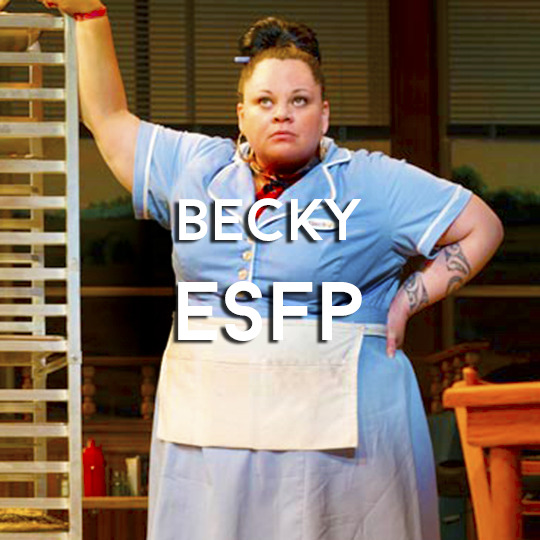
Becky from Waitress
ESFP
by Rebecca
requested by anonymous

Extroverted Sensing (Se)
“I didn’t plan it, but that’s life, and I’m finally feeling alive. It’s not right, but it’s mine, and it’s finally something to feel.”
Becky’s life with her husband and in the diner can leave her feeling numb, and she does all that she can to break free and feel something again. She explains that her affair with Cal happened suddenly and without much thought – it was an opportunity that presented itself and she took it. She is not a typical thrill seeker, but she is far from afraid of excitement of any kind coming into her life, particularly if it breaks through the monotony. She understands the practicalities of life and is able to stay grounded in this way. Still, not ever wanting more would leave her suffocated – she takes chances when they come.

Introverted Feeling (Fi)
“I don’t claim to be proud, but my head won’t be hung in shame.”
Becky is loyal to those she cares about, but isn’t afraid to call something out if she feels it is wrong. Despite having an affair, she refuses to be ashamed of her actions, instead understanding where they came from. When Jenna starts to shame her, Becky turns the tables to show that Jenna is doing the same thing and doesn’t have any moral superiority. Most of the time, Becky is deeply caring for her fellow waitresses, helping them in whatever way she can. No matter what happens, she provides support for them while staying true to herself and her own morals.

Extroverted Thinking (Te)
“C’mon sweetie, it’s better to know.”

Becky’s logic is strong, preventing her emotions from overriding all of her sense even in intense moments. She is confident in her knowledge of a situation: if she knows what has happened, she knows well what will happen. She tends towards a no-nonsense demeanor, keeping things to the point as much as she can among her more nervous coworkers. She is witty, twisting the reality of a situation into quips that come naturally. Her personality is strong, and she isn’t afraid of taking charge of a situation if it seems fit.

Introverted Intuition (Ni)
“I wouldn’t call this place a happy end, but I been ‘round the block and just came back again.”
Becky isn’t always considering the long-ranging implications of her actions, preferring to live in the moment. She is aware of the state of her life and understands that she needs to find comfort within it rather than beyond. Her dreams for the future are more vague: she just wants a happier life where she can experience and feel more. Her more pragmatic approach to life is at odds with senseless idealism, but that doesn’t mean she is immune to wishing for something more. She knows that fully achieving her wildest dreams is not likely, so she is able to find happiness in the opportunities she does seize.


Support us on Patreon and Ko-Fi!

Hi! I hope you’re having a nice day :) I LOVE your blog so much! I was just wondering if you think theatre actors of certain types would find it easier or harder to portray characters that are different types from each other or from their own type? Like is there a particular type you think would be able to step into the shoes of characters of different types than them easier? Christian Borle comes to mind because of Will Shakespeare vs Emmett Forrest, but I’d love to know your view. Thanks! xx

Hello!

The short answer is yes, I would believe actors of different types than their characters may have more of a challenge inhabiting a role than one who shares the type. Of course, playing a character who isn’t exactly like you is a major part of acting, and you’re expected to respect the character. (Side note: MBTI can be a useful tool for understanding a character who is very different!)

As for specific types that might have an easier time inhabiting characters different from them, I would say feeling types (or thinking types with strong, healthy feeling functions) might have an advantage. Much of modern acting technique is focused on truthful emotions and vulnerability, and being in touch with one’s own emotions as well as those of others (Fi and Fe) can be very useful in this regard. Having emotional intelligence is vital for any actor, and may come more easily for feeling types – therefore, they can more easily play a character of a different type from their own.

But, to reiterate, this is a possible natural advantage rather than a definition of those who can act as characters unlike themselves. Anyone who develops healthy and strong feeling functions, even IxTPs and ExTJs with inferior feeling functions, can be excellent actors who can slip into any role.

– Rebecca 

image

Martha from The Children’s Hour
ISFJ
by Rebecca
requested by @its-lacrimohsa-not-lacrimosah

Introverted Sensing (Si)
“I had been looking forward to some place by the lake – just you and me – the way we used to at college.”
Martha has found the place where she feels most comfortable, and feels threatened whenever someone attempts to change this. She is highly attached to Karen, and wants their lives to stay both together, and the same. When she realizes that Karen and Joe will get married and likely leave her alone, her emotions tend to get out of control. Then, once rumors threaten the foundation of her life, she finds herself lashing out more and unable to deal with a world that is changing so rapidly. There is no way for her to get back to the way things used to be, and because of this she struggles going forward.

Extroverted Feeling (Fe)
“No! You’ve got to know. I’ve got to tell you. I can’t keep it to myself any longer. I’m guilty!”
Martha struggles with understanding her own feelings – it isn’t until they are bursting out that she begins to realize what her emotions really are. Her irritation with her aunt, for instance, bleeds out as they argue over Lily’s place at the school. Trying to keep in her feelings towards Karen ends up in an explosion that ends in tragedy, with her inability to manage her own feelings and no outside support. She feels a great deal of connection to others, especially as she cares for Karen and wants to support her well-being. Part of the reason she meets her end is due to guilt over the pain caused in other people’s lives.

Introverted Thinking (Ti)
“Aunt Lily, the amount of disconnected unpleasantness that goes on in your head could keep a psychologist busy for years.”
When she wants to be, Martha can be witty and analytical towards the world around her. She displays this clearly when speaking to her aunt Lily, as she brings up issues of logic to dispel the melodramatic responses. She shows an intensity that rises when emotion alone cannot possibly pull her through her current situations. As such, she is not afraid to confront Mrs. Tilford about the lies cast toward her and Karen. However, Martha’s own structure of logic cannot keep her calm and in control when her emotions get too strong.

Extroverted Intuition (Ne)
“There must be something we can do to you, and, whatever it is, we’ll find it.”
Martha is described as nervous and high-strung, worrying about the future more than she embraces it. She struggles with seeing alternate futures, focusing instead on how she wants things to stay the same. She faces a break as the rumors begin to overtake her life and destroy everything she has been building, leaving her unsure of what direction she can turn next. When is thinking up different ways of moving forward, it is because she is forced to, not because she wants to. Without any true sight forward, she ends up taking her own life rather than face a world that is dissolving in chaos.


Support us on Patreon and Ko-Fi!

image

Tracy Turnblad from Hairspray
ENFJ
by Owen
requested by anonymous

Extroverted Feeling (Fe)
“Everybody says that a girl who looks like me can’t win his love, well! Just wait and see!”
Tracy is a warm, bubbly, and excitable girl who charms many people in her life with her enthusiasm. She gets into the Corny Collins show by impressing Corny with her spirit at the Sophomore Hop while doing “The Madison”, and her energy eventually spreads to the rest of Baltimore and makes her famous. She immediately falls in love with Link in “I Can Hear The Bells” after bumping into him, and she also cares a great deal about her friends, Motormouth Maybelle and Seaweed, involved in the civil rights movement and does what she can to protest their necessity for equal rights.

Introverted Intuition (Ni)
“The world’s gonna wake up and see Baltimore and me!”
Tracy is extremely idealistic, which leads to situations both good and bad. She always looks towards the future, even when she is arrested during the protest. Her original dream is to be a famous dancer on The Corny Collins Show, and she works towards making that dream a reality. When she meets Link in “I Can Hear The Bells”, she throughly envisions the rest of her life with him in an instant, much like how she does when she says on the air that she would make The Corny Collins Show, and the rest of America, integrated if she were the President of the United States.

Extroverted Sensing (Se)
“And you can try to stop my dancin’ feet but I just cannot stand still…”
There’s no doubt that Tracy lives in the moment, as she acts on a whim many times. She loves dancing, which drives her dream to be on The Corny Collins Show and become a council member. She loves feeling pretty and styling her hair in outrageous ways, enough that her teacher warns her that her hair is too high. She finds the good and exciting in Baltimore, seeing various possibilities in it even as the city is in civil unrest, as is the basis of “Good Morning Baltimore”. Tracy appreciates all kinds of art and music, from the bubblegum pop on the TV to Maybelle’s rhythm and blues.

Introverted Thinking (Ti)
“This morning, life was a Baltimore fairy tale. Now I can’t make bail.”
Tracy doesn’t often use logic when faced with a problem; instead she uses her heart (Fe) and her instincts (Ni) to act on the spot (Se). This can be seen both when she tries to get on The Corny Collins Show even though she knows that it will be challenging to get it, and when she leads the protest without realizing that she could be arrested and lose her spot on the show. Tracy presents herself as carefree and happy-go-lucky without much thought to what others think of her, but it becomes apparent that the girls’ remarks about her weight do, in fact, bother her quite a bit.

Support us on Patreon and Ko-Fi!

image

Pippin (INFP) and Catherine (ENFP) from Pippin

by Rebecca

INFP: Fi Ne Si Te

ENFP: Ne Fi Te Si


Catherine and Pippin’s relationship may have been set up by the Leading Player, but their connection goes far beyond anything that was planned for them. While at first they don’t get along, their love drives them to fight and stay together even as everything falls apart. This is reflected in their MBTI types of INFP and ENFP. They have similar, but not identical types, with the same functions in a slightly different order.

Each of them has high introverted feeling (Fi) in their function stacks. This is the dominant and auxiliary function for Pippin and Catherine, respectively. They both are developing their senses of self during the events of the show – Pippin trying to find how he can find his place in the world, and Catherine realizing she doesn’t want to go along with the players any longer. Their mutual affection helps them to realize both of these, as Pippin finds that where he needs to be is with her and she finds her feelings for him outweigh the Leading Player’s desires. Their strong individual personalities may cause clashes in the beginning of their relationship, but as they get used to one another it builds them higher.

They also share extroverted intuition (Ne) in high positions: Catherine has dominant Ne, while Pippin has auxiliary Ne.
Both are open to change and excitement, especially when it comes to meeting one another and eventually falling in love. Catherine starts to see the potential in Pippin earlier on, whereas it takes him some time to realize his affections for her. Part of this process is Pippin trying idea after idea after idea for Theo’s duck, which greatly endears him to Catherine.

Introverted sensing (Si) is Catherine’s inferior function and Pippin’s tertiary. Catherine claims to be moving on from the past with her first husband – and in many ways she is – but it isn’t until Pippin comes along that she truly breaks from the cycles. Pippin, on the other hand, deeply struggles with doing repetitive work on the estate. For each of them, these issues are more or less resolved by their interactions, appearing in one another’s lives and creating change that appeals to their high Ne.

The final function in their stacks is extroverted thinking (Te), Pippin’s inferior function and Catherine’s tertiary. Neither one of them demonstrates that they have much power over the world, with Pippin utterly failing as king and Catherine staying content with running her estate. Together, however, they are able to fight back in their own way, effectively breaking down the system that the Leading Player has set up. They tend not to be focused on logical solutions, instead giving into their feelings.

With such similar MBTI types, it’s clear that Pippin and Catherine could just as easily clash as they fall together. Their relationship brings them together to defy the players, staying to their own values and ideas.


Support us on Patreon and Ko-Fi!

image

Papi (INTP) and Haled (ENFJ) from The Band’s Visit

by Rebecca

INTP: Ti Ne Si Fe

ENFJ: Fe Ni Se Ti


Papi and Haled forge a fast friendship after their meeting, coming to trust one another quite quickly. Their relationship echoes the themes of The Band’s Visit, with its focus on creating an unexpected connection. Their personalities, as their MBTI types, are highly different – one is an introverted thinking type, while the other is an extroverted feeling type. But these differences are far from tearing them apart – in fact, they complement one another in numerous ways.

Haled and Papi have the same dominant and inferior functions, but flipped. The first example of this is Haled’s dominant fuction – extroverted feeling (Fe) – as Papi’s inferior function. Fe is about social interaction and charisma, which Haled naturally exudes and Papi greatly struggles with. Part of the reason Papi reaches out to Haled is because he notices this quality, and finds that Haled can help him grow in this respect.

The other way around is Papi’s dominant introverted thinking (Ti) versus Haled’s inferior Ti. Papi is mostly contained within himself, but Haled struggles when he isn’t sharing with others. Though Papi diminishes his intelligence, it is clear he takes a more logic-based approach towards situations while Haled tends toward emotions. Both of them experience their feelings overtaking their logic, but due to their respective functions they deal with it in distinct ways.

Haled and Papi each have auxiliary intuition functions – introverted intuition (Ni) and extroverted intuition (Ne). They each tend toward metaphors when discussing their experiences with love, but Papi’s collide and twist whereas Haled’s flow together. Haled is able to understand people quickly and easily, and his intuition is helpful for this. Papi, on the other hand, tends toward anxious, out of control thoughts when faced with talking to a girl.

In a similar vein, they each have tertiary sensing functions: Papi has introverted sensing (Si) and Haled has extroverted sensing (Se). Each of them display awareness of a moment in their own ways – Papi is overly aware of how he is freezing up, while Haled can see the beauty of the world around him. Haled understands the outside sensory world and uses it in his description of love. But Papi seems to be stuck in his own cycles concerning relationships.

Haled ends up being the exact person that Papi needs when he wants to make a connection. So many of the places where he finds he falls short are where Haled excels, and through this they are each able to learn from one another. Their friendship comes quickly, bringing a great deal of trust and understanding.


Support us on Patreon and Ko-Fi!

image

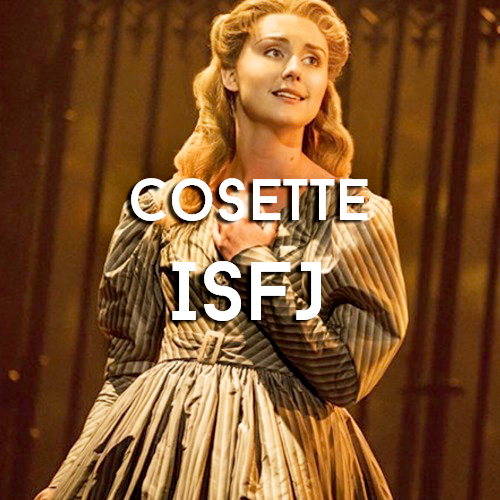
Cosette from Les Miserables
ISFJ
by Owen
requested by spookilyfallinginlove and anonymous

Introverted Sensing (Si)
“Every day, we’ll remember that night and the vow that we made.”
Cosette looks to the past and what has happened – or at least, what she remembers happening – for guidance. She withholds the importance of tradition and family many times, such as how she defends her father from those who accuse him of wrongdoings and when she marries Marius. She is extremely loyal to those she cares about and is focused on promises from the past, as seen in “Every Day” when she reassures Marius that she will never go away.

Extroverted Feeling (Fe)
“This is a chain we’ll never break!”
Cosette is warm and loving, charming multiple people within her life. When Valjean first meets her after “Castle On a Cloud”, he is immediately enamored by her politeness and takes her in. The same thing happens many years later when Marius meets her in the town square, and she falls in love with him immediately. In “A Heart Full of Love”, she opens up to Marius and lets him inside her home, proving her trust for him. She values harmony and kindness above all else.

Introverted Thinking (Ti)
“There’s so little I know that I’m longing to know…”
Cosette has an intelligence and strength to her that is often under-examined. She attempts to use logic to make sense of the dark world around her that is always changing. In “In My Life”, she looks back at what just happened (her encounter with Marius) and makes an effort to decipher her feelings for him, soon after prying her father for answers about his past life. However, Cosette’s analyzation is most often used with inferior Ne when she is under pressure.

Extroverted Intuition (Ne)
“Does he know I’m alive? Do I know if he’s real? Did he see what I see? Did he feel what I feel?”
Cosette has lived a very sheltered life under the watch of Jean Valjean, and thus views the world with fresh eyes. After she meets Marius for the first time, her mind flits from idea to idea, even convincing herself that Marius isn’t real. She cannot immediately comprehend Valjean’s past life, nor the upcoming revolution that puts her life and the lives of those she cares about in danger. Even when she marries Marius, she worries about the past catching up and stopping their relationship.

Support us on Patreon and Ko-Fi!

Maria Rainer from The Sound of Music
ENFP
by Rebecca
requested by anonymous

Extroverted Intuition (Ne)
“Raindrops on roses and whiskers on kittens, bright copper kettles and warm woolen mittens, brown paper packages tied up with strings: these are a few of my favorite things.”
Maria wants excitement in her life, and the nunnery simply cannot provide this for her. She is playful, and understands how and why the von Trapp children need some fun in their lives. Unlike many of the others around her, she is highly willing to take chances and make changes. Maria tends to be idealistic and looking forward to bigger and better things in her life, usually with a good deal of optimism. It is rare that she finds herself in a situation where she cannot find one solution or another, even if rather unorthodox.

Introverted Feeling (Fi)
“My heart wants to beat like the wings of the birds that rise from the lake to the trees…”
Maria is unabashedly herself – she knows she is different in many ways, but isn’t ashamed of it. She doesn’t conform to the ideas set up for her by others, instead finding her own place in the world as Maria von Trapp. Generally, she is at ease with her emotions and rarely needs outside help until she finds herself falling for Captain von Trapp. She feels things deeply, gaining affection for the von Trapp children and true love for the Captain. She remains loyal to those who have given her care, whether she keeps her connection to the other nuns or returns to the von Trapp family.

Extroverted Thinking (Te)
“When you read you begin with ABC, when you sing you begin with do, re, mi.”
Maria may not seem like the best sort to be a governess to a lot of troublesome children, but she finds she is able to slip into a state of leadership quite well. She avoids trying to make the world under her control, and instead finds delight in what it gives her. However, she also rejects a great deal of the structure that has been set out before her, finding it doesn’t work with her. As such, she breaks through the Captain’s militaristic approach to raising his children. She is able to create structure her own way with flexibility (Ne), helping her to grow close to the von Trapp children.

Introverted Sensing (Si)
“I’ve always longed for adventure, to do the things I’ve never dared. Now here I’m facing adventure…then why am I so scared?”
For most of her life, Maria seems to be wanting to break free and do something more than she always has. Generally, this translates to excitement about new possibilities and change, rejecting the cycles she has gone through. She breaks through the routines of the von Trapp family life, making something new. When she finds herself utterly confused by her feelings for the Captain, she runs back to what she know up as as a nun. She has nostalgic feelings about the mountain she grew up on, and grows into deep loyalty and attachment for the von Trapp family.


Support us on Patreon and Ko-Fi!

image

Papi from The Band’s Visit
INTP
by Rebecca
requested by anonymous

Introverted Thinking (Ti)
“No…I hear the sea.”
Papi can look at his world from a logical standpoint, as he realizes how strange his predicament surrounding women is. He has a self-awareness about his thoughts and experience that sometimes gives way to self-loathing, but in general help him to understand where his problems lie. He claims a lack of intelligence, likely as his personal logical patterns don’t match those of the outside world. Instead, he lives within his own world, needing exterior help to find control. Being alone seems to come more naturally to him than being social, no matter what kinds of connection he wants.

Extroverted Intuition (Ne)
“And my tongue gets big, and I can’t move my knees, and my eyeballs freeze, and all I see’s a tunnel.”
It is clear that Papi is no stranger to spiraling thoughts and worries, letting himself get carried away in a moment. When describing his experience of trying to talk to and listen to girls, he uses a variety of metaphors that tend to get twisted and overlap. This likely reflects his inner thought process, as even when he remains silent his mind is spinning. He can also see possibilities and jump at them if it feels right for him, whether he’s trying to break up the beginnings of a fight or get advice from someone who understands romance. For instance, once he gets Haled’s advice, he jumps into it without any hesitation, seeing that it could work out for the best.

Introverted Sensing (Si)
“Go and tell me I should keep on trying.”
In some ways, Papi is stuck in a cycle of thoughts and behaviors – not unlike many of the inhabitants of Bet Hativkah. He wants to form a connection with women, but the same thing happens again and again as he hears the ocean. When a woman is talking to him, Papi is uncomfortably aware of how nervous and awkward he feels in a variety of ways. His self-awareness is quite intense, as he gets so stuck within his own mind and body that he cannot begin to think straight. It takes an outside source and opportunity to shift this personal cycle of his, as he cannot find a way out on his own.

Extroverted Feeling (Fe)
“I don’t know, with the girls, I don’t know what to do, I don’t know where to start.”
“Papi Hears the Ocean” centers around one fact: Papi struggles to form emotional connections and socially interact with women. He claims that though he is not very intelligent, he is even less intelligent when it comes to matters of the heart. He defends Haled when they first meet, trying to diffuse the tension that has built up in the area. Then, he is open to what Haled has to say, realizing that the outside help could be useful. Though he is naturally awkward, he wants to make connections with others and displays a fair deal of openness to these situations.


Support us on Patreon and Ko-Fi!