hey i know this doesn’t really have to with theatre but seeing as you are really knowledgeable about myers-briggs what personality types go with each other (meaning which personality types would be most compatible for in a friendship/relationship)?

Hello!

My first thought is that, really, MBTI doesn’t matter too much when it comes to compatibility. Anyone can be friends or partners with anyone else, at the end of the day. This is especially because MBTI, despite what people might think, is not a definition of personality. It can inform personality traits, but it doesn’t decide them.

With that being said, different MBTI types certainly interact in different ways. That’s the basis of the

Character Dynamics

series here on this blog – and I’ve definitely noticed some patterns there. One thing that’s pretty common in close relationships is, surprisingly, what I call “function flips” – basically, they have the same cognitive functions but flipped, so you get INFJ/ESTP, ISFP/ESTJ, etc. Similarly, people with no functions in common tend to complement each other well. 

Perhaps it’s a kind of balance. But, then again, people of similar types can work well together, too. I’m an INFJ, and my two best friends are INFP and ENFP. We’re a trio of intuitive feelers, and we get along very well. 

So the answer is…could be anything, really. I feel more comfortable, in theory, with spending time with other introverts and feelers. But I’ve bonded with people of all different types!

– Rebecca (INFJ)

I think it’s important just to stress that types don’t really matter as long as you make an effort to understand them (not necessarily even through MBTI, but in general). I don’t have a singular best friend but my closest friends are INTJ, ISFJ, ENTP, ENTJ, ISFP, ESFJ, and ENFP — all of which are so different, but in some cases we had to learn to “go with” the way the other worked. 

My ISFP friend, for instance, always makes plans an hour before; with my inferior Ne, that stresses me out, but I have to make that concession when I can, and then we have an amazing time (and that’s true, though less so, of my ENTJ friend as well). 

Sometimes I feel disconnected from my closest ENXP friends because they don’t ever tell me any stories about their life, while I’m telling story after story about that hilarious thing our mutual friend did in second grade before English class; I just have to remember that they don’t have this extremely intense connection to past experiences.

Interactions like that don’t have to be categorized through MBTI — it’s also just better understanding your friends and becoming better friends through that understanding — but the point is, anyone can be your close friend if you’re willing to work for it.

– Lelah (ISFJ)

I think that MBTI is so often kinda treated the same as astrology with how some signs are ‘compatible’ or what not but MBTI is a completely different system that’s specifically based on figuring out your strengths and weaknesses and how to apply those to the world around you; so as long as you use your knowledge in a healthy and positive manner, the types don’t really matter.

– Owen (INFP)

Henry Higgins from My Fair Lady
ESTJ
by Lelah

Extraverted Thinking (Te)
“There isn’t an idea in your head or a word in your mouth that I haven’t put there!”
Authoritative and commanding, Higgins demands that his associates adhere to his own rules and ideas, and he quickly makes concrete plans for the future on which he invariably follows through. Not only does he exert control over his environment, he believes that he himself can shape his entire life through his own command; in “I’m an Ordinary Man,” he repeats that he’ll never “let” a woman enter his life. As a result of his belief in his own control, he is absolutely perplexed when Eliza deserts him, interrupting her vitriolic criticism in “Without You” to assure her that this was his plan all along and refusing to “let” her leave, even threatening to wring her neck if she deigns to teach phonetics on her own. Even once she returns after a clearly devastating absence, Higgins only demands of her, “Where the devil are my slippers?”

Introverted Sensing (Si)
“Why can’t the English teach their children how to speak?”
Higgins holds tradition in high value, scorning those who break from it, and unquestioningly stands by the British class structure. Every dialect he hears informs him of its speaker’s social class, and he judges them accordingly, espousing the values of old “proper” English while expressing disdain for Cockney dialects like Eliza’s. Higgins sees distinct differences between social classes and believes that social ascension is impossible without adopting the conventional manners of the upper class; he helps Eliza transform into the exemplar of a lady by having her imitate upper-class traditions until she becomes one.

Extraverted Intuition (Ne)
“You see this creature with her kerbstone English; the English that will keep her in the gutter to the end of her days? Well, sir, in six months I could pass her off as a duchess at an Embassy ball.”
Though entrenched in social tradition, Higgins sees the possibilities of the future with little difficulty.He is initially disdainful of Eliza due to her lower-class dialect and behaviors, but once he is convinced to let her stay, he immediately devises a plan and a set of rules for her stay, determined that he’ll be able to make her into a woman of class — not simply a lady in a flower shop, as Eliza wishes, but a duchess.

Introverted Feeling (Fi)
“Will I take her in or hurl her to the wolves? Give her kindness or the treatment she deserves?”
For the most part, Higgins ignores his emotions; once his conviction in his control breaks down, however, he is forced to confront his feelings towards Eliza, and then still fails to articulate their true depth, asserting that he’s only “grown accustomed to her face.” In general, Higgins sees no need to treat others with much kindness, even regardless of their class; when Eliza tells him how much greater an impact Colonel Pickering had on her development than Higgins himself did, as “he treats a flower girl as if he were a duchess,” Higgins replies, “And I treat a duchess like a flower girl!”

Support us on Patreon and Ko-Fi!

image

Donny Novitski from Bandstand
ENTJ
by Rebecca
requested by @ravenclaw-in-rehearsal

Extroverted Thinking (Te)
“Whatever it is, whatever it takes, whatever bookings we can get we take them all. If there’s a club in town where we can play a set, we are not finished yet.”
Donny is a natural leader, taking his ideas for the future and putting them into action with efficiency and precision. He organizes the band by bringing it together, and then falls into position as its leader. He is purposeful and motivated, not letting money or other people get in the way of his dream of getting to New York City. This is shown in “Right This Way,” where he presses the band to take every gig they can to get money, acting as a leader even in his darkest moment. Donny is always planning, always trying to move forward, always taking the reins to find success and satisfaction in his life.

Introverted Intuition (Ni)
“Donny Novitski knows this is a lifeline, a once in a millennium shot, and I’m gonna take it, take aim at my target, and hit it with all that I got.”
Donny is always looking ahead, aiming toward a specific goal to make it in reach. From the very beginning of the show, he has been aiming for one thing: going to New York City to perform and become famous. This overarching goal leads him to create his band of all veterans, letting nothing stand in his way as he gets them through the various trials of the contest. He sees past the way America is treating its veterans, preferring emotional authenticity and truth (Fi). Even when things don’t go according to plan, he finds a way to keep everything as momentum.

Extroverted Sensing (Se)
“It’s a gutsy risk we’ll be taking. Times like this, you hold on to what’s real. That’s the honest statement we’re making.”

Donny is not afraid of risk-taking when he feels it is justified, launching into new ideas if he believes they can bring him forward. Almost immediately after hearing about the contest, he decides he absolutely must go for it. He decides, last minute, to have Julia sing the original “Welcome Home” lyrics despite the risk of losing the contest. He is a natural creator and performer, demonstrated through his composition skills and his long history of playing music. Donny knows when to step forward and take risks, reading the moment to find his advantage.

Introverted Feeling (Fi)
“What happened over there is true. What this band means to all of us is true. What I feel for you, Julia, is true. No matter how tough it is, no matter how much time it takes, I need to be with you. That is true.”
Donny is in touch with his emotions as he returns from World War II, sometimes all too much. He feels immense guilt over the death of his best friend, which he feels is his fault. He is constantly grappling with these feelings, though they are not always externally apparent. Donny constantly reinforces the importance of having an all-veteran band because of its emotional authenticity in the midst of showy patriotism. He cares immensely about truth, carrying this forward even as his band grows in following and fame.


Support us on Patreon and Ko-Fi!

image

The Astronomer from Ghost Quartet
INTP
by Rebecca

Introverted Thinking (Ti)
“And I never saw anything I couldn’t blame on my mind, so I don’t believe in ghosts.”
The Astronomer is driven by a sense of intellectual curiosity, a desire to understand the way the world works through logic. He discusses the man in Iran who can talk to ghosts solely because hasn’t talked to anyone alive and seems intrigued by the idea. However, he also realizes the logical limitations of this – the experiment would take far too long to carry out. He believes there is a way to figure out everything logically, even something supernatural like ghosts. For the most part, he keeps to himself in his treehouse, suspended away from others.

Extroverted Intuition (Ne)
“I’m confounded by music, and babies and laughter, and stories and goodness, infinity and luck.”
The Astronomer is interested (and confused) by countless facets of life, drawing from all kinds of sources and ideas. His prime fascination is the sky, particularly all the stars and heavenly bodies it contains. He enjoys learning about all elements of the sky, and he shares this enthusiasm with others. He is carried forward by a sense of curiosity, which only grows as he learns more about the universe. A new fact means new questions and ideas, which in turn send him into new interests.

Introverted Sensing (Si)
“I love the way you see the world, I love the way your soul sings. I wish that I could sing like you, I wish that I could feel things.”

The Astronomer, despite all of his ways of looking out into different ideas, can get caught in cycles. He builds a connection with Rose Red, as demonstrated in “The Telescope”. However, he ends up having an almost identical relationship with Pearl later on. The Astronomer laments the fact that he can’t seem to dedicate himself to certain things, such as practicing singing. He seems to struggle with keeping things constant and steady, as he keeps getting drawn to new ideas (Ne, Ti).

Extroverted Feeling (Fe)
“Wait, wait, Rose Red, we were never—we never—”
The Astronomer is not the best at articulating feelings, nor is he great at understanding the emotions of others. He has somewhat of a relationship with Rose Red, but doesn’t think of it as such. When she blows up at him for playing with her feelings, he doesn’t understand what he has done. He is more charming than he gives himself credit for, with both Rose Red and Pearl White gaining affection for him. He doesn’t actively seek out these relationships, and seems rather shocked that they come to him.


Support us on Patreon and Ko-Fi!

Cornelius Hackl from Hello, Dolly!
ENTP
by Owen

Extroverted Intuition (Ne)
“Out there… there’s a world outside of Yonkers!”
Cornelius is always looking for an adventure, and he has the enthusiastic mind full of whirling ideas and thoughts to get him to where he wants to be. Dissatisfied with his life as one of Horace Vandergelder’s clerks, he longs to experience new things and explore all the different opportunities he imagines happening outside of his small ‘hick’ town. He persuades Barnaby to close the shop and come with him to New York in “Put On Your Sunday Clothes,” mentioning many possibilities for them to explore – most importantly, kissing a girl. Cornelius enjoys moving forward, seeing the value in pursuing whatever comes his and Barnaby’s way.

Introverted Thinking (Ti)
“I bet you could know a woman for a hundred years without ever being really sure whether she liked you or not.”
Cornelius is highly intelligent, even though he sometimes gets himself in over his head. He knows what to do to close the shop – explode tomato cans to create a stench – and to convince Irene and Minnie that he and Barnaby are rich – explain that walking to Harmonia Gardens gives an air of “Elegance.” His endless energy is concentrated through his logical analysis, but he learns that he can also make good decisions trusting only his emotions, such as when he gets out of court by telling everyone about his love for Irene. Cornelius’ multiple monologues also present his inner mind at work, showing that his logic is his and only his.

Extroverted Feeling (Fe)
“Your heart knows in a moment that you’ll never be alone again.”
Cornelius is very charming in an absurdly awkward way, with an innocence about love and intimacy: after all, his main goal on his and Barnaby’s excursion is to kiss a girl. He yearns to be in love after finding no such thing in Yonkers, and is instantly smitten when he meets Irene, as he describes in “It Only Takes a Moment.” However, he is so in love with her that he entangles him and Barnaby in a web of lies in order to woo her, only to discover that she fell for the kind, thoughtful, and likeable man he is. He establishes deep connections with many people throughout his adventure, and is liked by everyone he meets – other than Horace.

Introverted Sensing (Si)
“Thirty-three years old and I still don’t get an evening free! When am I going to begin to live?”
Cornelius is bored and fatigued with the monotony that comes with working as a clerk at Vandergelder’s Hay and Feed, presumably having worked there for a very long time. He isn’t interested in living the simple life of those around him, and finds more excitement in breaking those rigid patterns. He craves for any opportunity that presents itself to him, ditching what he has left behind in favour of something new. Cornelius loses his job and his security (“Everything people think is important”) during his adventure after Horace fires him and Barnaby, but he doesn’t mind because he was able to explore New York and fall in love with Irene.

Support us on Patreon and Ko-Fi!

Jane Porter from Tarzan
ENTP
by Rebecca
requested by anonymous

Extroverted Intuition (Ne)
“It’s such a liberating feeling, and it’s happening to me. I’ve never felt this glow inside.”
Jane doesn’t quite fit with the British society she was raised in, so arriving at the jungle allows her to be free. She sees a whole new world of possibilities that is both enthralling and familiar. Tarzan is like nothing Jane has ever seen before, and after a bit of initial fear she embraces the idea of learning about him. She takes it upon herself to teach him about human society, even though there is no prior knowledge available for her to do so. Not only is she easily excited by what is new, but she takes action towards such possibilities.

Introverted Thinking (Ti)
“It seems he learned from all around him. They’re like his friends, you see.”
Jane’s adventure to the jungle is partially done out of intellectual interest about the life there. She wants to take notes on the different plants and animals she encounters, and is particularly fascinated by Tarzan. Jane always wants to learn, and her pursuit of knowledge is deeply internal and tied to how she wishes to engage with the world. Even when Jane is caught in a web, about to be consumed by a giant creature, she is still taking down notes and information. Her desire to understand the world comes from a place of analysis and genuine interest in new possibilities (Ne).

Extroverted Feeling (Fe)
“This affection I feel is getting the better of me.”
It takes Jane a good deal of time to realize what she is feeling even as it becomes apparent to those around her. She is kind by nature, and tries to resolve situations while avoiding conflict. Though the gorillas are initially wary of Jane, she remains calm and kind in a way that allows them to trust her. She understands the importance of meeting the gorillas, and knows that Clayton cannot intrude on that environment. She is then accepted into their family, finding a connection through Tarzan.

Introverted Sensing (Si)
“Here and now nothing matters, everything I wanted’s here. I feel at home, I’ve found my place.”
It seems that Jane has been seeking freedom from the restraints of society all of her life. She feels like the jungle is her home almost immediately, despite it being so different from everything she has ever known. She and her father are interested in challenging preconceived notions about the wildlife, especially gorillas. Jane finds Clayton closed-minded, and thus is far more attracted to Tarzan and the possibilities he represents. When she realizes she can stay in the jungle, she decides it is worth it rather than returning to human society.


Support us on Patreon and Ko-Fi!

image

Maureen Johnson from RENT
ESFP
by Owen
requested by seasons-of-stories

Extroverted Sensing (Se)
“The only thing to do is jump over the moon…”
Maureen is eccentric, out there, and extremely performative. Her ‘job’ as a artist requires her to captivate everyone around her, as seen during her bizarre performance of “Over The Moon.” She loves being the center of attention, such as the chaos of the riot that her protest of Benny’s gentrification starts. Maureen barely thinks before acting, instead choosing experiences – or romantic partners – when they present themselves. As well, multiple characters comment on Maureen’s attractiveness throughout the show.

Introverted Feeling (Fi)
“Take me for what I am; who I was meant to be.”
Maureen is fiercely independent and herself, refusing to bend to the rules and desires of others. This is best showcased in “Take Me Or Leave Me,” as she fights with Joanne for complaining about her flirtatious behavior – if Joanne, or anyone else, can’t accept her for who she is, then she lets them go. Maureen, however, does have a strong moral compass inside her and a passion for activism, which leads her to perform a protest piece and attempt take the padlock off of the door in “Happy New Year B.”

Extroverted Thinking (Te)
“This time you can shoot from the start, you’ll direct, starring me!”
Maureen can often seem to have no logical ability whatsoever, but this isn’t true: her logic is just different than everyone else’s. She is an opportunist that uses what is in her resources to benefit her and (sometimes) others. After Mark gets a call from Buzzline after his footage of Maureen’s protest gets on the news, she immediately comes up with a plan for another protest in “Happy New Year B.” She can also lack compassion in the way she uses her logic, as seen with how she acts towards Joanne during “Take Me Or Leave Me.”

Introverted Intuition (Ni)
“Don’t give me that face.”
Maureen rarely seems to be looking for anything in the long run, instead focusing solely on the present. She jumps into situations without much thought, and the thought that is put into it usually only serves her, such as her plan for another protest. Along with her unhealthy Fi, she has a habit of not realizing how her actions may hurt others in the future, such as her flirtations with other people outside of her relationship with Joanne. Maureen seems perfectly content with not looking deeper, which can make her seem superficial.

Support us on Patreon and Ko-Fi!

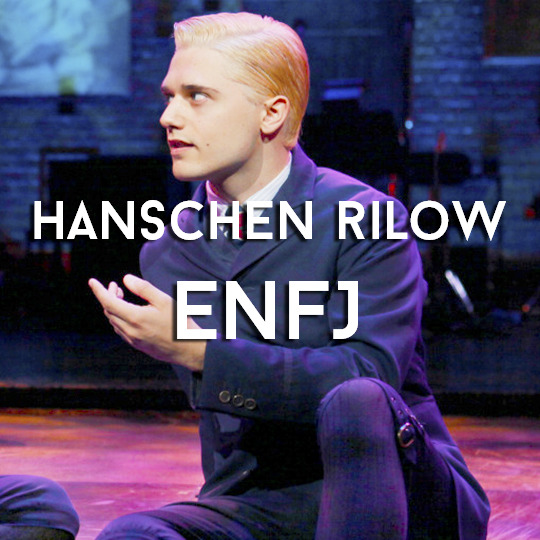
Hanschen Rilow from Spring Awakening
ENFJ
by Rebecca
requested by @eriksfavoritecape, @northfox, and anonymous

Extroverted Feeling (Fe)
“It’s like, just kiss some ass, man – then you can screw ‘em all.”
Hanschen is very charismatic, and he is aware of this fact and how to use it. His awareness of social systems allows him not only to fit himself in, but also how to manipulate it to work for him. He can easily see how people can be swayed to one side or another, and uses this insight to his advantage (Ni). Hanschen avoids voicing any controversial opinions, preferring to keep things to himself rather than cause trouble. He believes that sticking by what is accepted will benefit him in the end, seeing nothing to gain by lashing out.

Introverted Intuition (Ni)
“Think of the future as a pail of whole milk. One man sweats and stirs-churning it into butter-like Otto, for example, Another man frets, and spills his milk, and cries all night. Like Georg. But, me, well, I’m like a pussycat, just skim off the cream…”
Hanschen is able to take a step back from the present moment, allowing him to see the greater patterns in the world. His insight into people (Fe) allows him to figure out how to advance himself. When explaining his worldview to Ernst, he utilizes an metaphor about milk, showing his abstract thinking. He generalizes the behaviors of the other boys into patterns, and then explains how his own way of living fits in. He is looking ahead at where he will end up in the future, seeing promise even when his present isn’t the best.

Extroverted Sensing (Se)
“We’ll huddle over the Homer. Maybe do a little Achilles and Patroclus…”

Hanschen is in touch with his sexuality, and is comfortable with it despite the attitudes of society. He can be flirtatious and seductive, as shown when he makes a move on Ernst. Their embrace has been long foreshadowed and planned by Hanschen, who has taken the time to figure out how best to share his feelings. He understands the importance of this moment even when he is in it, seeing that in the future it will be intensely beautiful (Ni). He is not much of a risk taker, tending not to speak his mind fully unless he is in private and won’t have repercussions for his words.

Introverted Thinking (Ti)
“But, you’re fucked if you speak your mind, and you know, uh-huh, you will.”
It can be difficult to tell how genuine Hanschen is, as he is very particular about what he does and does not say. Hanschen’s means of moving forward in life rely on other people and how they behave. As such, he rarely voices any controversial opinions, staying in line to keep his place in society (Fe). He is a good student, but it seems he works less out of genuine interest and more out of keeping his social standing. He shows a deep understanding of the structure around him, but makes no effort to change any of it.


Support us on Patreon and Ko-Fi!

image

Ti Moune from Once On This Island
ENFP
by Rebecca

Extroverted Intuition (Ne)
“Send me to places where no one before me has been.”
Ti Moune is always looking ahead, filled with excitement for what could lay before her. She isn’t disturbed by the idea of change and uprooting her life – in fact, it intrigues her. She seeks deeper meaning in her life, seeing the gods putting her in a tree as a sign that they have a greater plan for her. She tends to be positive about her experiences, seeing a world of possibility that allows her to defy what people claimed was impossible to change. Her solutions to problems are not the most straightforward, but suit her best, such as how her love can overcome death even after she promises herself to Papa Ge.

Introverted Feeling (Fi)
“Even the gods won’t dare to cross this line, where my life is forever yours and you are mine.”
Ti Moune has a deep well of emotion that drives her actions, creating loyalties and spreading love. Her love for her family keeps her grounded, even as she leaves them behind. She feels a deep connection to Daniel almost immediately, forming an emotional bond that stays constant despite outside gossip. When Daniel reveals he is already betrothed, Ti Moune refuses to bend to the position of becoming his lover on the side. Her unbreakable love allows her to defeat even death, becoming a tree that protects and breaks down barriers.

Extroverted Thinking (Te)
“But for now, walk slowly, Daniel.”
Though she is young, Ti Moune is filled with wisdom and drive that carries her through her journey. When she finds an injured Daniel, she spares no time in taking control of the situation. She doesn’t spend time setting out particular details, but often makes plans through creating goals she wishes to achieve. She isn’t afraid to aspire for things beyond her home, firmly showing her presence and power in the world. She challenges the expectations of both the peasants and the grand hommes, but is unable to create lasting change until she becomes a tree.

Introverted Sensing (Si)
“What I am, you made me. What you gave, I owe. But, if I look back, I’ll never go.”
Ti Moune is not interested in following the patterns of the people around her, and the simple life everyone else is living. She is deeply loyal to her parents, but knows that her destiny does not lie in staying still. Her feelings for home and the past are important to her, though she is always looking ahead. No matter what, Ti Moune refuses to settle even as the world around her presses her to give into despair and death. She remains loyal to those she loves, but instead of letting that loyalty keep her in one place she uses it to make life better for them.


Support us on Patreon and Ko-Fi!

Have you considered INFP as Natasha’s type in Great Comet? She seems to take a very black and white look at reality, as seen in Sonya and Natasha, and refuses to consider other perspectives when she has made up her mind. I could also see her having higher Ne which could be what attracts her to Anatole and makes her detached from the rest of the world at times. She doesn’t seem to have a distinct set of morals, but she seems to be searching for them (“I don’t know good from bad”)

Hello! 

You’ve probably already seen our typing of Natasha as an ISFJ, but if not the link is there! 

When typing Natasha, I initially thought of her as an ENFP – and, knowing how she acts in War & Peace especially, I think there’s a very strong case for as an NFP type. The reason I didn’t go for any NFP type revolves around the difference between Fi and Fe.

Natasha is constantly looking for external support and validation for her feelings. She is used to being adored without really trying (”Everyone has always liked me”) and finds pleasure in getting attention (”They’ll like me so much/The women envious/The men calming their jealously”). 

But perhaps the biggest push towards her as Fe rather than Fi is how she changes her feelings to suit the people around her. When Helene comes around and tells her about Anatole’s feelings, she hesitates but then to think “it must be all right” because of Helene’s behavior. She then takes Anatole kissing her to mean she loves him, even though she was resisting him all night.

If she was a high Fi type, this kind of reasoning would be much more unlikely because she would have more internal emotion and image to drive her. It’s definitely not impossible – none of our typings are ever supposed to be considered 100% correct with no other possibilities, and War & Peace Natasha certainly demonstrates a lot of NFP-ish behavior. But within the context of The Great Comet, FJ suits her better in my mind. 

– Rebecca