image

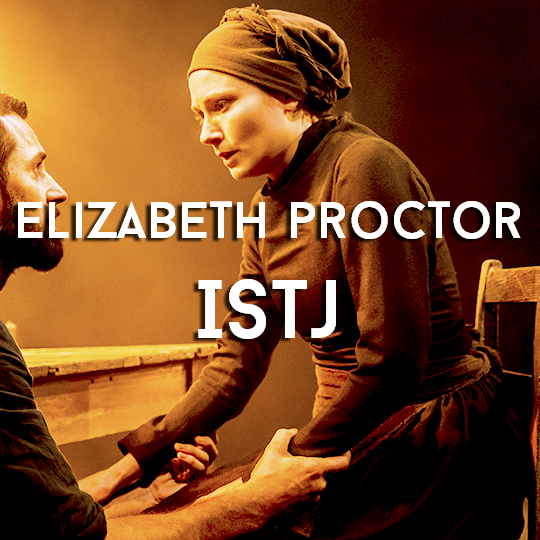
Elizabeth Proctor from The Crucible
ISTJ
by Rebecca
requested by @iifthiswereamovie

Introverted Sensing (Si)
“John, I counted myself so plain, so poorly made, no honest love could come to me! Suspicion kissed you when I did; I never knew how I should say my love. It were a cold house I kept!”
Elizabeth is doing her best to be perfect within the expectations of her community, doing many of her duties as a wife without complaint. She acts as a housekeeper and mother, avoiding the problems of the Salem witch trials until they come to her directly. She does not question the expectations set upon her, always staying within the lines. She is loyal to John and their marriage even until their final moments, finding ways to protect him and their marriage. Despite the intensity that overthrows her life, Elizabeth stays constant and moral through it all.

Extroverted Thinking (Te)
“You’ll tear it free—when you come to know that I will be your only wife, or no wife at all! She has an arrow in you yet, John Proctor, and you know it well!”
Elizabeth is deeply intelligent, able to understand situations as they arise even in the mayhem of the Salem Witch Trials. She determines, correctly, that Abigail is acting to get rid of her so that she may have John all to herself. She is able to take together all of the information in the outside world and synthesize it to come up with the correct conclusion, then acting to prevent it from coming true. She knows when to make demands of others and be stern, particularly when she needs John to stop speaking with Abigail. She is deeply intelligent and presses when she must, always searching for the correct conclusion.

Introverted Feeling (Fi)
“He have his goodness now. God forbid I take it from him!”
Elizabeth struggles with warmth, but throughout the events of The Crucible she forges an intense loyalty and love for her husband. She blames John’s adultery on herself, claiming that she was far too cold towards him and should have been more openly caring.
For much of the play she struggles with opening up about her emotions, finding difficulty in outwardly expressing her feelings She refuses to admit that her husband had an affair with Abigail, lying so she can protect his name and honor. Though this does not align with social norms, it shows that Elizabeth has a morality that is not easily swayed by the mania and falseness of the outside world.

Extroverted Intuition (Ne)
“There be a thousand names; why does she call mine? There be a certain danger in calling such a name—I am no Goody Good that sleeps in ditches, nor Osburn, drunk and half-witted. She’d dare not call out such a farmer’s wife but there be monstrous profit in it.”
The chaos that overtakes Salem with the beginning of the witch trials repels Elizabeth, who prefers to stay in control. When she is named in the witch trials, she points out that she has no good reason to be called a witch due to her usual proper behavior. She, unlike some of the women in Salem, never goes outside the lines of what is expected of her – except for when she lies to protect John. It isn’t until Mary Warren gives her the poppet that she becomes truly intertwined with the witch trials, as she had been waiting by the side up until that point. She would’ve been content to keep her simple and quiet life, but her husband’s affair made chaos unavoidable.


Support us on Patreon and Ko-Fi!

Tewfiq (ISTJ) and Dina (ENTJ) from The Band’s Visit

by Rebecca

ISTJ: Si Te Fi Ne

ENTJ: Te Ni Se Fi


The two characters at the heart of The Band’s Visit, Dina and Tewfiq, form an unexpected bond when the ceremonial band stays overnight in Bet Hativkah. They forge a connection that neither one seems to fully understand. Their MBTI types, too, are somewhat different at first glance. But, looking deeper, there are plenty of similarities that tie them together.

Extroverted thinking (Te), Dina’s dominant function and Tewfiq’s auxiliary function, is their highest shared cognitive function. Though Dina tends more towards the bold and sometimes abrasive, Tewfiq shows that he is not afraid to take charge when he finds it necessary. After all, he is the leader of the Alexandria Ceremonial Police Band. Both have turned to a life that generally pushes away wild idealism, preferring instead a kind of pragmatism.

The other function shared between Dina and Tewfiq is introverted feeling (Fi), Dina’s inferior function and Tewfiq’s tertiary. Both are rather guarded about their emotions at first, with Dina covering up her feelings with wit and Tewfiq simply remaining quiet. But through a shared interest in Arab movies and music, they begin to connect on a deep and intense level, letting their feelings come through. This comes to a peak in the park when they share music and Dina experiences “Something Different.” However, after this, the two struggle to communicate fully, with Tewfiq shying away from Dina’s advances.

For his dominant function Tewfiq has introverted sensing (Si), whereas for her tertiary function Dina has extroverted sensing (Se). Tewfiq is more adverse to chaos, preferring a sense of structure and order in his life. Dina, on the other hand, is more vibrant and risk-taking, pushing others to join her. This leads to Dina often dominating the conversations, pushing Tewfiq to talk to her, share stories with her, sing for her.

For their intuition functions, Tewfiq has inferior extroverted intuition (Ne) and Dina has auxiliary introverted intuition (Ni). Dina is constantly looking forward and beyond, finding a deep connection with Tewfiq after initial impressions. Tewfiq, on the other hand, tends to be much more restrained, avoiding things that are out of control. While the two share an intense bond, Dina is far more likely to push onward while Tewfiq fears it and pulls back.

At first glance, Dina and Tewfiq are enormously different, both in personality and in MBTI types. Beyond the surface, however, is a great deal of similarity that causes them to develop an intense connection, while their internal differences ultimately lead them struggling to sustain it.


Support us on Patreon and Ko-Fi!

image

Elsa from Frozen
INTJ
by Owen

Introverted Intuition (Ni)
“I know I’ll never see that sunny day when this trial is finally through.”
Elsa plans far ahead from the present in order to try to stay in control, which feeds on her fears. In “Dangerous to Dream,” she describes the negative outlook she has on the future, ‘knowing’ that she will never be able to have a normal relationship with Anna and be able to effectively rule Arendelle. Her parents imbedded this sorry into her when she was a little girl, leading to years of predictions on Elsa’s behalf. She makes a lot of metaphors in order to describe how she feels, such as calling herself a monster in a cage or someone with a frozen heart.

Extroverted Thinking (Te)
“If I’m a monster, than it’s true; there’s only one thing that’s left for me to do!”
As a queen, Elsa naturally uses her logic to guide her thoughts and decisions. After she accidentally strikes Anna when they are children, she isolates herself from her as that is what makes sense to Elsa. She also uses her analysis when it comes to Anna and Hans’ quick engagement, as she (correctly) tells Anna that she cannot be engaged to someone she met a few hours ago. Her pragmatism can again be seen in “Monster,” as she ponders about what she should do in order to save Arendelle, even contemplating suicide as a means of sacrifice.

Introverted Feeling (Fi)
“Let it go, let it go… that perfect girl is gone!”
Elsa has an entire world of emotion within her that she doesn’t show anyone else, much to the chagrin of those who want to get close with her, such as Anna. This can be seen in “Dangerous to Dream,” as she laments that she has had to keep to herself for so long. After she showcases her ice powers at the coronation party, she decides to “Let It Go” and start living for herself, no longer worrying about what anyone else will think. Elsa has a rigid moral compass, telling her what is right (trying to save Arendelle) and wrong (getting engaged to a stranger).

Extroverted Sensing (Se)
“Make one wrong move and everyone will know.”
As Elsa likes to use her logic to predict what will happen next and act as is required, she is at her most destructive when she acts within the moment without much thought. The plot begins when she is playing with Anna as a child and accidentally strikes her with her magic, as she is young and doesn’t know better. This happens again twice, at the coronation party and when Anna finds her ice castle in “For The First Time In Forever Reprise”: both moments of heated argument. When her world spins into chaos, she is unable to decide what do to next.

Support us on Patreon and Ko-Fi!

image

Tewfiq from The Band’s Visit
ISTJ
by Rebecca
requested by anonymous

Introverted Sensing (Si)
“It’s the sound of water, and waves…distant children playing on the beach…and the sound of the bait, falling in the water. In the early hours, on the sea, you can hear the whole world like…like symphony.”
Tewfiq, through his many experiences in the world, has developed habits and structure that allow him to carry through life in spite of negative feelings underneath. He has led his band well, developing its reputation through specific ways of working and acting that he enforces. He is very clear about what he does and does not want from his band, and is not afraid to take action to make sure everyone stays in line…especially Haled. He has an intense connection with music and the experience of conducting, finding beauty within the sensation. He is generally reserved, saying only what he feels is necessary to get his point across.

Extroverted Thinking (Te)
“We are here to represent our country, and as always we will do so with the highest standard of both musicianship and professionalism.”
Tewfiq knows how to take charge of a situation as well as when to back off, preferring structure and order to any sense of chaos. He functions as a strict leader of the band, making sure to keep his authority clear alongside his professionalism. He makes this very clear when instructing the band of what to do at the beginning of the show, acting with precision and authority. No matter what happens, he tries to remain professional and pragmatic, including when the band ends up in the wrong city. He moves immediately towards leaving and taking the necessary steps to prevent any issues in the future, and it is only the need for food that leads him to stay.

Introverted Feeling (Fi)
“Itgara’a. Itgarahoum. Inta el wihda. Inta el farah. Itgarahoum.”
Tewfiq tends to keep his deeper feelings to himself, but finds moments to share what he feels whether through music or discussion. He opens up about his emotions to Dina, specifically when it comes to his experience of music and his personal life. With her he is able to talk about beauty and love, moving past his facade of a strict, intense band leader. Even when speaking of the tragedy of his family, he remains fairly steady – he feels the emotions deeply but doesn’t necessarily display them intensely. His inner emotional state is always present, even if it is not readily apparent to those around him.

Extroverted Intuition (Ne)
“I was hard with him. I didn’t understand. He was gentle, and fragile…like her. I…I didn’t understand him.”
Tewfiq is adverse to chaos and things not going to plan, and prefers not to create any kind of trouble in his surroundings. When he opens up to Dina about his wife and son, he shows that he struggles with handling things that don’t fit into his prior understanding. He feels guilt over what happened to his family, feeling that his strictness led to them falling apart. He seems somewhat overwhelmed by getting stuck in Bet Hativka, only finding comfort when he starts to connect with Dina over Arab movies and music. Tewfiq tends to stick to what he knows, although this doesn’t always turn out well for him.


Support us on Patreon and Ko-Fi!

image

Orpheus is something fairly rare in media – a male ENFJ. He is openly emotional and idealistic, contrasting greatly with the more pragmatic and guarded Eurydice. 

Fe-dominant men aren’t seen often in shows because they don’t fit the typical traits of men. Usually, fictional men are thinking types, whose emotions are reserved for moments of weakness. But Orpheus is a welcome and notable divergence from this trend. He is open about his feelings, whether it is his love for Eurydice or his despair over losing her to Hades. 

Even further, Orpheus breaks through a variety of ENFJ stereotypes. Many ENFJs are viewed as overly warm and fuzzy without a thought in their brains, interested only in harmony and socializing. Either that, or they’re horrifically manipulative, using people’s own feelings against them. Clearly, Orpheus doesn’t slot easily into these ideas – but he’s still quite the ENFJ. 

Orpheus is guided by his emotions throughout the events of Hadestown. He falls in love with Eurydice easily and quickly, and is able to charm her into taking a chance on him. He has dominant external feeling (Fe) charisma, which makes him easy to adore and follow. He follows his emotions to retrieve Eurydice from Hadestown, and openly cries out over losing her. This, too, has its own kind of charm – his external emotions catch the attention of Persephone and the workers of Hadestown, sparking somewhat of a rebellion. As Hades says, “with his kiss, the riot starts.” All of this is a sign of dominant Fe, without the fuzzy, overly focused on harmony stereotypes.

Orpheus’s introverted intuition (Ni) and extroverted sensing (Se) also break through expectations of male characters and ENFJs. Of all the characters in Hadestown, Orpheus is usually the most optimistic and positive, looking forward to a highly idealistic future through his Ni. This positivity is unusual for many male characters, but suits Orpheus perfectly. He is also a musician who enjoys a simple and free life, a facet of his Se. In this way, Orpheus’s Se is fairly well-developed, with him avoiding the stereotype of being too impulsive and thrill-seeking. 

Orpheus is a fascinating character for many reasons, and his MBTI is certainly a part of that. As a male ENFJ, he is refreshing and complex within the events of Hadestown.

image

Rose from Ghost Quartet
INFJ
by Rebecca
Note: As Rose is several people within the context of the show, this typing is focusing specifically on the two incarnations named Rose – Rose Red, and the modern photographer Rose.

Introverted Intuition (Ni)
“I see fire in the darkness, rage against the void. I see every time man cried out and raised his sword against God.”
Rose is constantly looking ahead, whether it be to put a plan in action or to see things from a larger perspective. Her plan to get revenge on the Astronomer and her sister is massive, reaching across generations and wide expanses of time. She chooses her one goal – in this case, revenge – and follows it even through reincarnation. The modern incarnation of Rose learns to expand her view of the world, putting together patterns to find her place. She has to disconnect from the presence to find that, in the grand scope of things, she is “the same as everybody else.”

Extroverted Feeling (Fe)
“If I told you this is special and love is more than chemicals, that it’s me and you and angels too and time will end and we’ll transcend and rise above the ash and dirt, and baby I could never hurt you, ‘cuz you are me.”
Rose is an emotional person, with her feelings often bubbling over and controlling her actions even when these actions are negative. As Rose Red, she launches into a blind rage after realizing the Astronomer is in love with Pearl and not her. She cannot bear to keep her emotions inside, and they end up guiding her towards revenge to inflict the emotional pain she feels on others. In her journey to get everything for the Bear, she can be manipulative, such as in her relationship with the Soldier. She understands other people’s feelings enough to use them to her advantage, in this case getting the various things for the Bear.

Introverted Thinking (Ti)
“I am not a puzzle, I’m not some fucking logic puzzle for you to figure out.”

Rose uses logic to figure out how to put her ideas into reality, but doesn’t always consider the farther reaches of her actions. She knows she cannot take her entire desired revenge without help, and thus ends up talking to the Bear. She can seek out help while also making up her own plans, figuring out the logic of getting everything the Bear asks for. However, she doesn’t think much about whether or not the Bear can actually help her, which ends up with her doing everything for nothing. The modern Rose has to remember and understand everything that has happened throughout the reincarnations, requiring a deep amount of thought and analysis.

Extroverted Sensing (Se)
“One little choice, one small action, one coincidence of thought and the lights went out.”
Rose struggles to take charge of the moment, finding that when she acts without thinking it can lead to unfortunate consequences. As modern Rose, she struggles with guilt over taking a picture of Pearl instead of helping her off the subway track. Her decision, made in a split second, leads her to “Hero,” where she questions everything about herself and her beliefs. This stems back to Rose Red’s desperate, angry decision to take revenge on the Astronomer and Pearl. The intensity of a moment can often be too much for Rose, leading to poor decision-making in her different incarnations.


Support us on Patreon and Ko-Fi!

Hello everyone!

It has recently become clear there are a lot of links that are broken or incorrect on the list pages. We are working on fixing this, though it might take a fair amount of time.

Thank you for your patience and support!

– Rebecca

Ernst Robel from Spring Awakening
INFJ
by Owen
requested by sidjenkins and anonymous

Introverted Intuition (Ni)
“Sometimes, when it’s quiet, in the evening like this, I imagine myself as a country pastor.”
Ernst mostly stays in his own head, imagining what his future holds to keep preoccupied from the oppressive world he lives in. When he is talking with Hanschen in the vineyard, he speaks of his idyllic ‘dream’: to live in the countryside as a pastor with a wife. However, Hanschen soon calls him out for it, revealing what Ernst truly wants. An idealist, he searches for the deeper meaning of his life when nothing seems to make sense.

Extroverted Feeling (Fe)
“Oh, no! I love you, Hanschen! As I’ve never loved anyone!”
Ernst cares a large deal about what others think of him. Carrying himself in a delicate manner, Ernst is shy and timid. He is extremely kind to everyone, even his academic rivals (such as Moritz, who fails in place of Ernst) and presumably the girls. This can best be seen in “The Word Of Your Body Reprise,” as he falls for Hanschen’s seduction and reveals that he returns Hanschen’s feelings, going as far to say that he is in love with him.

Introverted Thinking (Ti)
“God, my whole life’s just some test.”
Ernst is not very academically intelligent, as he is failing in school, but he has a great amount of depth to him. Most of his logic is filtered through his emotions first, as he is curious about how he fits in the society around him. In “The Bitch of Living,” he starts to analyze his own attraction to boys, as if life is ‘testing him.’ As he doesn’t know what is happening with him, he shows himself to be willing to learn about the more sensual things in life (Se).

Extroverted Sensing (Se)
“Touch me, just like that…”
Ernst has trouble acting within the moment, preferring to look within himself and wait for the coming times. When Hanschen kisses Ernst in “The Word of Your Body Reprise,” Ernst is initially taken aback as he thought they would only talk, but Ernst quickly takes initiative for the first time and kisses him back. Ernst frets about his burgeoning sexuality, but as his solo in “Touch Me” shows, he isn’t as frightened by what he feels as Moritz is.

Support us on Patreon and Ko-Fi!

image

Julie Jordan from Carousel
ISFP
by Rebecca
requested by anonymous
Note: This typing contains mentions of abuse.

Introverted Feeling (Fi)
“If I loved you… It wouldn’t make no difference what you’d – even if I died for it.”
Julie keeps her emotions close to her chest, but it is apparent that her feelings are always present and guiding her forward. She doesn’t tell Billy that she loves him until he is dying, keeping her emotions from him until she can’t anymore. Her feelings are deep and powerful, but she doesn’t vocalize them until Billy’s last moments. She tends to be quiet and elusive about her own feelings, causing others to note “You’re A Queer One, Julie Jordan.” Her feelings are deep and driving, but she rarely feels the need to openly share them with others.

Extroverted Sensing (Se)
“When you walk through a storm keep your chin up high and don’t be afraid…of…the…dark…”
Julie isn’t afraid to make a decision in the moment, taking a chance on something new and exciting. She decides to stay with Billy after he loses his job, even though it means risking her own. This is a decision she makes more or less on the spot, deciding to stay despite the consequences – losing her job and possibly her reputation. She has a strong physical attraction to Billy in addition to her deep love for him. Their relationship begins on a whim after he lifts her onto the carousel, and continues with an unsteady passion even as her love for him solidifies.

Introverted Intuition (Ni)
“But somehow I can see just exactly how I’d be, if I loved you…”
Julie isn’t always looking at the bigger picture, but she has moments where she can step back and look ahead. This is seen very well in the song “If I Loved You,” where she describes a clear image of how she would act if she was in love with Billy. She looks into the future and is able to see it with clarity and accuracy, especially as much of what she says comes true. She claims at the beginning of the show that she’s never going to marry anyone, but this does not turn out to be true. Julie is able to step back and see greater patterns in her life, finding Billy’s presence even after his death.

Extroverted Thinking (Te)
“Common sense may tell you that the ending will be sad, and now’s the time to break and run away. But what’s the use of wond’ring if the ending will be sad?”
Julie tends to keep to herself and avoid enforcing any change in the world, even in some of her more personal matters.
She tends not to protest whenever things don’t go her way, particularly when it comes to her relationship with Billy.
She swallows her feelings even though she feels hurt by Billy’s behavior, choosing instead to keep to herself.
She is far less bold than her cousin Nettie or her friend Carrie, preferring to find some sense of control in her own life. She is rarely abrasive or forceful, unless she feels that her inner feelings are threatened or questioned.


Support us on Patreon and Ko-Fi!

Balaga from Natasha, Pierre, and the Great Comet of 1812
ESFP
by Rebecca
requested by anonymous

Extroverted Sensing (Se)
“Risking skin and life twenty times a year, for my fine, fine gentlemen.”
If Balaga is interested in anything, it’s excitement and thrill. His business is based off his high speed troika rides, which throw caution to the wind. He does not mind the risk at all, because it gives him something exciting in his life. He has been known to get into dangerous situations “more than once,” allowing him to build up a reputation. He looks forward to when he gets to drive his troika, because it will give him excitement, alcohol, and companionship.

Introverted Feeling (Fi)
“I don’t do this for rubles, I do it cuz I like ’em!”
Balaga, though he is a risk-taker, is also loyal to his customers that he takes on his troika rides. He does his job not for money, so much as for alcohol and because he enjoys the company. He knows plenty of secrets from his customers, but keeps them to himself. His morals are guided primarily by how he chooses to experience life for the thrill of it all (Se). He does not seem overly concerned about whether what he is doing is right or wrong – he certainly doesn’t care much for the law.

Extroverted Thinking (Te)
“And the troika tore down Nikitski Boulevard!”
Balaga is able to follow the plans set for him, even though his thrill-seeking behavior might lead people to believe otherwise. He follows the plan given to him by Anatole for the elopement, taking Anatole and Dolokhov to where Natasha is. He doesn’t falter, however, even when the plan falls apart and Marya drives Anatole away. He doesn’t seem to care about thinking plans through for himself, nor taking charge. He can adapt when he must, paying attention to what is happening in front of him (Se).

Introverted Intuition (Ni)
“Who knows things that would get you sent straight to Siberia if anyone found out?”
Balaga doesn’t look ahead much, instead preferring to live in the moment and enjoy everything it can offer. He takes up the job of troika driver without thinking of the consequences, even with an elopement involved. Unlike Dolokhov, he isn’t worried about what might happens – all that he thinks about is what is in front of him. He doesn’t worry about looking deeper into the situations because it frankly does not matter to him. He carries secrets about those who take his troika rides, but is loyal enough not to release these secrets into the world where they could lead to trouble (Fi).


Support us on Patreon and Ko-Fi!