I believe what you are referring to are the numbers next to “Characters from [Show]” requests! Because we get a fair number of requests, and there are so many characters in theatre, to keep ourselves sane we keep the request for unspecified characters in a show limited to 3 characters.
1/3 means we have typed or are typing one character, 2/3 means two, and 3/3 means we are working on the third character.
I hope this makes sense!
– Rebecca
Hello everyone!
First, we want to apologize for not getting out any posts last week, and not explaining this sooner. As it was a holiday week, we decided to focus on taking a break for Thanksgiving.
But, speaking of the holidays, we have good news! 25 Days of MBTI is coming back, but this time with a twist: we will branching out into Enneagram typings! These will be added to existing MBTI typings, one every day from December 1 to December 25.
Introverted Intuition (Ni) “I wish I was a cowboy. They’re free. They just swing up and then it’s miles of grass…”
Alan demonstrates a complicated but intense inner world that causes his to develop a religion toward horses and break out into violence. Throughout the play, the sources of Alan’s religion become clear, stemming from certain and definitive sources. Though unusual and unique to Alan himself, the development of his horse worship comes from riding a horse when he was young and stories from his mother. Alan’s religion is full and complex, with its own internal rules and concepts that he accepts fully. His inner self is so disconnected from the rest of the world that it becomes something completely its own.
Extroverted Feeling (Fe) “She did it! Not me. It was he idea, the whole thing!…She got me into it!”
Though Alan is undoubtedly unique, he forms understandings of the world through the thoughts and actions of other people. Much of what Alan says and does can be traced back to the complicated relationship of his parents. With a highly religious mother and an atheist father, the strain over religion has characterized his life for some time and materializes in creation of his own religion for Equus. He is attracted to Jill, and ends up giving in to what she wants much of the time, wanting her reciprocated affection. Despite his unusual tendencies that separate him from the rest of the world, he is still highly affected by others, with their own thoughts and desires.
Introverted Thinking (Ti) “Who said ‘Religion is the opium of the people’?”
Alan is remarkably observant, to the point he is quickly and easily able to make conclusions for himself. He quickly ascertains the patterns in the mental hospital, in particular realizing that Dysart is missing passion in his life. Though he cannot figure out everything, Alan is able to push Dysart to reveal much of his own problems and sometimes avoid telling his own truths. His inner world (Ni) has its own internal structure, with consistent rules that all connect within Alan’s mind. To outside observer’s, Alan’s actions do not make sense – but Dysart getting inside his mind makes his internal thoughts clear.
Extroverted Sensing (Se) “I couldn’t take my eyes off them. Just to watch their skins. The way their necks twist, and sweat shines in the folds…”
Many of Alan’s problems stem from his difficulty interacting with the physical world, particularly with confused messages about sexuality. His obsession with horses, alongside its highly spiritual component, is also highly sexualized and focused on the sensual experience of riding a horse. When he discusses horses, he talks about the sensual, immediate aspects of it first, and then these lead him to a more general reverence (Ni). However, he also seems to be frustrated with the superficiality of modern society, from their focus on brands to all kinds of men seeing a pornographic film. He seeks something more raw and real, which is what he finds within his personal religion toward horses.
In Sweeney Todd, there is certainly one central character: Sweeney himself. But without Mrs. Lovett, it is very unlikely he would’ve ended up in the mythic place as the Demon Barber of Fleet Street. The relationship between Mrs. Lovett and Sweeney Todd initially seems unusual and strange, but with a closer look their complementary natures come forward. This is shown in their MBTI types – they are nearly flipped functions, with Lovett as INFP and Todd as ENTJ.
Sweeney Todd’s dominant function is introverted feeling (Fi), while Mrs. Lovett has Fi as her inferior function. Todd seeks a kind of twisted justice, with his personal morals and desire for revenge dominating his actions. Mrs. Lovett, on the other hand, does not appear to have many moral quandaries at all. Mrs. Lovett is able to capitalize on Todd’s desire for revenge and use it for her own means, particularly to get closer to him – her prime emotional concern.
Mrs. Lovett’s dominant function, extroverted thinking (Te), is then Todd’s inferior function. Mrs. Lovett is often scheming and thinking of ways to get herself up in the world, often disregarding the feelings of others. Todd, on the other hand, feels powerless over the corruption and chaos of the world, and finds that his only way to assert power is through killing. But Todd’s decision to kill – and then to help those bodies become pies – are highly connected to Mrs. Lovett pushing him and supporting him to act in certain ways. Her prodding and plotting directly influences his actions.
Both characters have auxiliary intuitive functions: Todd has extroverted intuition (Ne) while Mrs. Lovett has introverted intuition (Ni). Both look beyond the immediate appearance of the world around them, seeking deeper meanings. Todd expands and shifts his ideas when he must, even though he is guided primarily by his main goal of revenge (Fi). Mrs. Lovett looks ahead to a comprehensive and developed goal: she wants to live with Sweeney by the sea and get married.
Similarly, both have tertiary sensing functions. Todd uses introverted sensing (Si) while Mrs. Lovett uses extroverted sensing (Se). Mrs. Lovett more easily acts in the moment in pursuit of pleasure and success, seen as she quickly leaps on using bodies to make pies and eventually become rich. Todd, on the other hand, is heavily fixated on the past, with revenge for previous events driving his sense of justice and his actions moving forward. Mrs. Lovett tries to draw him to her way of living, enjoying the moment and letting time go by, but the past eventually comes back to destroy both of them.
The two core characters of Sweeney Todd, Mrs. Lovett and Sweeney Todd himself, are very different people. Yet their relationship in the show is what drives both of them to their ultimate demises, with their complementary MBTI types allowing them to build off of one another in ways they could not alone.
We are not typing any other character at the time, the “Characters” request includes Julia.
– Rebecca
Archibald Craven from The Secret Garden ISTJ by Owen
Introverted Sensing (Si) “She has her eyes, the girl has Lily’s hazel eyes. The eyes that left me closed and all alone.” Archibald is plagued with immense grief for the past, specifically the death of his wife, Lily. Afraid to move on, he has let his house grow dark and Lily’s garden grow neglected, physical manifestations of his hopelessness. When Mary moves into Misselthwaite Manor, he is intent on raising her with as little interaction as possible until he notices in “Lily’s Eyes” that she bears a striking resemblance to Lily. As the story progresses, he is driven to insanity and starts seeing Lily everywhere (“Where In The World?”) until he is able to find closure with her ghost in “How Could I Ever Know?”.
Extroverted Thinking (Te) “I couldn’t speak, my heart grown cold.” Archibald, since Lily’s death, prefers to carry out plans in a methodical manner – at least in a way that makes sense to him. He is quick to enforce rules to his staff, Colin, and Mary at the beginning of the story, appearing cold and strict. He applies this structure to everything in his life, even believing that he has passed on a curse to Colin that would make him a hunchback, thus restricting him to his bed. Eventually, he leaves Misselthwaite at Neville’s suggestion, believing that it would be the best for himself and the manor’s despondent inhabitants before coming back at Mary’s urging.
Introverted Feeling (Fi) “Must I wander on tormented place to place to place to place?” Archibald doesn’t often let his emotions show, but it is clear that he has plenty of inner feelings within him. The flashbacks in the show paint him as being much happier and warmer than he is when we meet him, having shut himself off from society after the death of his wife and fallen into a deep depression. He struggles to be warm towards Mary and Colin, finding that he cannot relate to them. Archibald attempts to share his emotions to Neville by telling him what he saw in a dream during “Quartet”, but Archibald cannot sense that Neville is manipulating him since he is caught up in his own melancholy.
Extroverted Intuition (Ne) “She needs a home! The one thing she really needs, I cannot give…” Archibald is scared to let go of his past life, instead attempting to find comfort in the gloomy Misselthwaite. Multiple opportunities to become a better man present themselves, such as Mary asking for “A Bit of Earth” and connecting with Colin, but he shies away, instead becoming complacent. By “Where In The World?”, he is driven mad by all the possibilities of change (and his grief) that become apparent to him, signaling that he must grow from who he has become even though it terrifies him. Archibald, at Lily and Mary’s urging, ultimately is able to become warmer and more open like he used to be when he sees his Lily’s garden brought back to life.
Li’l Bit from How I Learned To Drive INFJ by Rebecca requested by @veronicasawyeet Note: Mentions of pedophilia, sexual abuse.
Introverted Intuition (Ni) “It’s 1969. And I am very old, very cynical of the world, and I know it all. In short, I am seventeen years old, parking off a dark lane with a married man on an early summer night.”
Li’l Bit is intelligent and forward thinking, finding solace in her own mind even when she cannot adjust to the exterior world. Even when her family doesn’t understand, she dreams of going to school and getting an education, moving to empower herself. She finds goals and dreams for herself, and moves toward them until external circumstances tear them apart. At the end of the show, as she remembers the moment everything changed with Peck, she says she retreated from her physical body to live only in her mind (Se). Li’l Bit defines herself through her thought and perceptions, showing a deep and complicated inner world whether she is speaking to the audience or trying to navigate a complicated world.
Extroverted Feeling (Fe) “We could meet and talk – once a week. You could just store up whatever’s bothering you during the week – and then we could talk.”
Li’l Bit is empathetic and careful toward others, particularly Peck, even when she may not necessarily want to be.
She starts spending time with Peck because she wants to help him with his drinking problem, even as he takes advantage of her kindness. Li’l Bit demonstrates an understanding of how her feelings and actions can affect others, and she tries to use this to the best effect. Her struggle with caring for others comes to a head when she tells Peck they have to stop spending time together, and he ends up holding her. She wants to run away and end her relationship with this man who has hurt her forever, but also truly cares about him and hates to see him suffering.
Introverted Thinking (Ti) “Oh – this is the allure. Being older. Being the first. Being the translator, the teacher, the epicure, the already jaded.”
At times, Li’l Bit wants to step back and analyze, using her thoughts to build a deeper, clearer understanding of the incomprehensible situation she finds herself in. Throughout the show, Li’l Bit addresses the audience, demonstrating the level of thought she has put into looking at her past. She shows moments of wittiness and self-awareness that show her capacity to know herself and her past actions. She shows genuine interest in trying to understand why Peck did the things he did, wanting to dig deeper and form a complete picture for herself. Much of the show is Li’l Bit’s journey to understand and process the events of her youth, showing her thought and logic alike.
Extroverted Sensing (Se) “That day was the last day I lived in my body. I retreated above my neck, and I’ve lived inside the ‘fire’ in my head ever since.”
Li’l Bit struggles with living in her physical body, especially ever since the sexual abuse with Peck began. She constantly struggles with how she exists physically, with people constantly noting her large breasts and treating her differently because of them. She starts to internalize this, cracking jokes while trying to ignore the unpleasantness and disperse tension. She has difficulties with alcohol, starting from her teens and carrying over into her college years. In many ways, the present moment and physical senses have failed Li’l Bit, so she tries to leave it behind as much as possible.
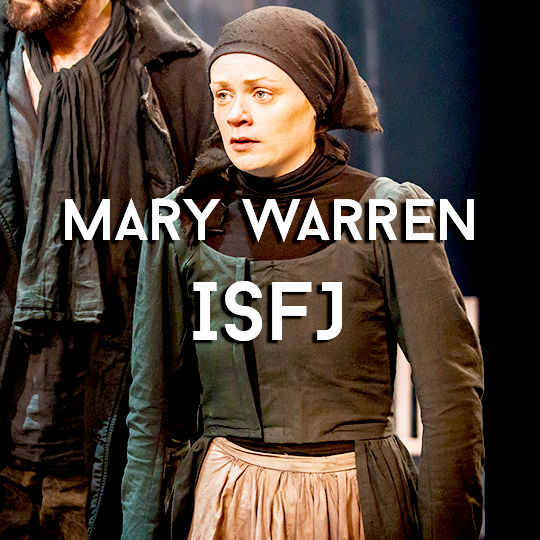
Introverted Sensing (Si) “I am amazed you do not see what weighty work we do.”
From the beginning of the play, Mary is constantly trying to stay inside the lines and avoid any kind of wrongdoing. She claims she never actually danced in the forest with the others, staying to the side and only watching instead. Mary does not want to do anything wrong whatsoever, preferring to stick with the rules and absolve herself of any potential problems. She has to be pushed significantly to do anything outside of her comfort zone, such as telling the court that the girls are lying. For Mary, her own safety and comfort comes first, usually leading her to align with the preexisting rules and power structures in Salem.
Extroverted Feeling (Fe) “I saved her life today…I said I never see no sign you ever sent your spirit out to hurt no one…”
Mary tends to be a follower, never a leader, constantly doing what other people want of her until she is pushed in another direction. She shows both respect and care for Elizabeth Proctor, speaking up for her in the court when her name was brought up in reference to witchcraft. Even though she is serving the Proctor family, this demonstrates her awareness of others and trying to do what is right and good in the existing framework. When the other girls gang up against her, pretending to see a bird in the courtroom, Mary struggles until she finally breaks and turns back to their side. She is caught between the truth and safety, and when she sees that speaking the truth actively endangers her she returns to the prevailing popular view, accusing John Proctor.
Introverted Thinking (Ti) “I told you the proof. It’s hard proof, hard as rock, the judges said.”
For the most part, Mary does not try to think for herself – she integrates what others say into her own understandings. She starts to show some resistance once she feels a sense of power from working in the courts, but this is short-lived. She presses that she is an adult and an official of the court, but John Proctor quickly pressures her back to servitude. She does not stop to truly consider why the girls are crying witchcraft and behaving so strangely in the court until she is forced to say that it was all a lie. It is only when her place of support and stability is threatened that Mary steps back to look more closely at her situation – and, even then, she is unable to come up with why the girls acted the way they did.
Extroverted Intuition (Ne) “Abby, we’ve got to tell. Witchery’s a hangin’ error, a hangin’ like they done in Boston two year ago! We must tell the truth!”
Mary is constantly frightened and worrying, tending to fret about what might happen if she doesn’t act in a certain way. She pushes Abigail and the other girls to tell about what they were doing in the woods in hopes that they can avoid punishment. Her mind immediately goes to the worst case scenarios, spiraling out of control until she can find a way to get things back into order. She is equally panicked about going to the court to reveal that the girls are lying and pretending to be attacked by spirits, knowing that Abigail will find a way to spin everything against her. Her fears inevitably come true, pushing her to the point where she turns against John Proctor and back to the other girls in order to protect herself.
Abigail Williams from The Crucible ESTP by Rebecca
Extroverted Sensing (Se) “We were dancin’ in the woods last night, and my uncle leaped in on us. She took fright, is all.”
Abigail takes risks, acting quickly and boldly in almost every situation she encounters. Before the events of the play, Abigail has both had an affair with a married man and danced in the woods while making a potion to kill Elizabeth Proctor. She shows herself used to jumping into risky situations wholeheartedly, and letting herself enjoy the moment while she is in it. She is quick to see potential profit or opportunity in front of her, and wastes no time in taking deliberate action. For most of the play, this serves her well – she has sway over the witch trials and therefore all of Salem – but it cannot last forever.
Introverted Thinking (Ti) “Don’t lie! She comes to me while I sleep; she’s always making me dream corruptions!”
Abigail knows not only when to act, but how and what to do, showing deep understanding of her circumstances.
During the hysteria in Salem, Abigail always seems to know what to say that will keep her on top. For instance, when the truth threatens to come out through Mary, she leads the other girls to claim that Mary is practicing witchcraft in that very moment until Mary cracks. She is also callous to other people’s feelings, not caring if people die so long as she inevitably gets what she wants. This is seen with how she threatens and manipulates the other Salem girls, continuing to lead them throughout the trials that put so many to death.
Extroverted Feeling (Fe) “You loved me, John Proctor, and whatever sin it is, you love me yet! John, pity me, pity me!”
Abigail is manipulative to those around her, showing an awareness of her own charisma that she puts to use to propel herself forward. She appeals to John Proctor, attempting to restart their relationship after she was turned out of the house. Despite her vicious behavior towards the other girls, she begs John to give her a “soft word” and pity her, appealing to whatever emotions he has for her. She becomes the leader of the girls who go to court, and they follow her behavior and example no matter what she does. She knows just how to threaten and treat others so that they do as she wishes, leading the entirety of Salem into chaos for her own desires.
Introverted Intuition (Ni) “ I saw Sarah Good with the Devil! I saw Goody Osburn with the Devil! I saw Bridget Bishop with the Devil!”
Abigail is often planning and plotting, but rarely considers the larger consequences of her actions.
Her initial decision to begin accusing others of witchcraft quickly spirals into something much larger, and Abigail continues to follow it through. People end up losing their lives, and yet Abigail does not seem to care much – she is fixated on getting Elizabeth Proctor out of the way. Her single-minded determination on having John Proctor to herself does inevitably lead to her downfall, when he reveals their affair and she starts to realize her domain is crumbling. Though her downfall is not immediate, she eventually runs away with stolen money, desperate to keep control over her situation (Se).



 Theatre MBTI