Hello everyone!

I know there’s been a lot of discussion and debate about what’s happening with Tumblr starting today, and I want to speak on that a bit!

Long story short: Theatre MBTI will not be deleted or moved, and will continue to function as before. 

I am backing up the blog on WordPress, and may choose in the future to move to another platform. But, for now, so long as Tumblr continues to function and this blog continues to have active followers, we will post content on here.

If anything changes, we will let you know!

I hope you are all enjoying the new Enneagram content as part of 25 Days of MBTI!

– Rebecca

theatrembti:

image

Elphaba Thropp from Wicked
INTJ
by Rebecca
requested by @scarlettyeung, @idontwannabethesupreme, and anonymous

Introverted Intuition (Ni)
“Unlimited, my future is unlimited, and I’ve just had a vision almost like a prophecy!”
Elphaba always finds a focus when looking towards the future, often dreaming of better things for herself and those around her. Throughout the show she has visions of the future, featured in “The Wizard and I” when she can picture “a celebration throughout Oz” and her time with the Wizard. Her dreams of the Wizard are quite idealized and she finds herself disillusioned when she finally meets him. Elphaba wants to look beyond obvious appearances, something she feels quite strongly about as she has green skin. She can sense when things seem to be going amiss in Oz, such as how she realizes “Something Bad” is happening in Oz early on.

Extroverted Thinking (Te)
“I’m through accepting limits ‘cause someone says they’re so. Some thigns I cannot change, but ‘til I try I’ll never know!”
Elphaba makes plans for what she wants to do, tending to rely on logic in many scenarios instead of emotion. Sometimes she tries to check her own feelings with logic, such as how she talks herself away from her feelings for Fiyero in “I’m Not That Girl.” This is also seen in “No Good Deed” as she analyzes her “good deeds” and believes that she might have only been doing it for attention. Other times she shows that prioritizes logic over other facets of one’s personality, such as how she initially shows disdain for Galinda in “What Is This Feeling?” and later criticizes her at the beginning of “Defying Gravity.” She desires a position alongside the Wizard in order to act as a leader for Oz and use her mind.

Introverted Feeling (Fi)
“No good deed goes unpunished. All helpful urges should be circumvented.”
Throughout the show, Elphaba remains independent and grows a strong base of emotions even as she becomes the Wicked Witch of the West. She demonstrates a strong desire to support the animals as she realizes that they are losing their powers of speech and being caged up. However, she sometimes struggles with her inner emotions and finds herself explosive when things do not line up with what she believes. She doesn’t bend down to anyone else’s desires, staying true to herself even when it could benefit her. This is seen at the end of the first act as the Wizard tricks her into making all the monkeys have wings and she realizes he has been suppressing the animals – even as he offers her all she’s ever wanted, she refuses because it is morally wrong to her.

Extroverted Sensing (Se)
“Kiss me too fiercely, hold me too tight. I need help believing you’re with me tonight.”
Most of the time, Elphaba doesn’t think or act in the moment, and when she does she can be somewhat reckless. Sometimes she makes impulsive decisions that end up aiding her, such as when she decides to fly in “Defying Gravity.” Other times, however, her impulses end up harming others. This is seen as she tries to save Boq’s life and ends up making him a tin man, and later feels she has failed to save Fiyero’s life by turning him into a scarecrow. She also hates her own external appearance and wishes that people could see beyond her green skin to all she has underneath, finding judgements based on physical appearance quite shallow. Elphaba does demonstrate physical attraction towards Fiyero, shown most prominently in the song “As Long As You’re Mine.”

image

Type 1: The Reformer
Wing 2: The Helper

The world may be unkind to Elphaba, but she puts energy into changing it and herself as a Type 1. She sees the deep injustice toward the Animals and puts forward her best efforts to help them. She is frustrated with everyone else who seems to be doing nothing, and expects them to say and do more. She becomes the Wicked Witch of the West because she refuses to give in to corruption and lower her standards. Though few know why she has become “wicked,” it does not matter, as she is keeping true to herself and pushing forward.

Much of Elphaba’s energy is directed towards others, often in terms of aid, showing her 2 wing. Her dedication to helping the Animals shows a selflessness and a deep desire to help others. She goes on to try to help several specific people – Dr. Dillamond, Nessarose, Boq, and Fiyero. She gives up trying to reach a good reputation later, finding that personally affecting others is more important to her. Her personal connections to Glinda and Fiyero, and the ways she has been able to help them while maintaining herself, are her core.

theatrembti:

image

Persephone from Hadestown
ESFJ
by Rebecca
requested by anonymous​

Extroverted Feeling (Fe)
“You want stars? I got a skyful. Put a quarter in the slot, you’ll get an eyeful. You want the moon? I got her too. She’s right here waiting in my pay-per-view. Ooh, how long’s it been? A little moonshine ain’t no sin.”
Persephone is highly charismatic, able to gain the respect and love of many of the inhabitants of Hadestown as shown in “Our Lady of the Underground.” She keeps her place by paying attention to the emotions of others – she gives them memories of the world they left behind and uses this to keep control. She is very sympathetic to Orpheus, seeing the boy singing for Eurydice and having pity on him and his cause. She usually approaches a situation with emotion first, whether it is her sympathy for others who are suffering or if it is a way for her to appeal to others. In this way she is able to make herself into a leader who others adore and thus have lots of loyalty for her.

Introverted Sensing (Si)
“That’s when I became his wife. That was in another life. That was in another world, when I was a young girl.”
Persephone is always looking to the past, whether it be her early relationship with Hades or the world she has to leave behind when summer ends. She seems quite sentimental for the way she used to be with her husband, but has also let it act as a lesson for her and others in the future. She thrives on giving memories of the past to the inhabitants of Hadestown, giving them glimpses of the world above. Sometimes she shows spite as the current times are so changed and so unlike the past that she strongly dislikes it, such as in “Epic II/Chant” when she argues with Hades for everything he has changed about Hadestown. She is also able to keep up with a routine, as she cycles between the earth and the world below every year.

Extroverted Intuition (Ne)
“I don’t know about you, boys, but if you’re like me then hanging around this old manhole is bringing you down, six-feet-under getting under your skin, cabin fever is a-setting in.”
As much as Persephone has found comfort in routine, she also finds quite a lot of despair in the fact that she is forced to return to Hadestown time and time again. She seems sick of her time in Hadestown, something that she uses in order to connect with others (Fe) in “Our Lady of the Underground.” While Hades seems very unwilling to let change occur in Hadestown when it comes to freedom, Persephone tries to convince him otherwise and let Orpheus and Eurydice go. However, as mentioned in Si, sometimes she dislikes changes such as the ones that Hades has made to Hadestown since she’s been gone. She says “it ain’t natural and it ain’t right,” displaying how she years for the times before and the relationship she used to have with Hades.

Introverted Thinking (Ti)
“What does he care for the logic of kings? The laws of your underworld? It is only for love that he sings! He sings for the love of a girl!”
Much of what Persephone does is through emotion primarily – logic means little to her, something which she tries to get her husband Hades to see. In “How Long?” she pesters Hades about logic versus love when it comes to Orpheus, trying to get him to bend to the way she sees things. Her decision to distribute memories of the world above to Hadestown appears not fully thought through, as she seems aware that Hades would be upset if he found out. Persephone relies a great deal on other people, which can be seen as her feeling less comfortable when she doesn’t have their love and support. Sometimes this leads to her to struggle when it comes to seeing eye-to-eye with Hades, as she defies his rule and tries to get him to change things as she pays more attention to the feelings of others than thought.

Type 7: The Enthusiast
Wing 8: The Challenger

Persephone is effusive, dedicating herself to the excitements of life as a Type 7. She immensely enjoys “Livin’ It Up on Top,” with all the joy and abundance she can find. Every element of summer is what she lives for, seeming the most like herself when she can be outside and partying. When in Hadestown, Persephone has to bring gifts from above in order to keep herself running through the winter, sharing them with the workers. She seems to enjoy the thrill of being “Our Lady of the Underground” and all the affection it entails.

One way or another, Persephone finds a way to get what she wants, with her 8 wing. She moves against the will of her husband and gives away mementos of the upper world behind his back. She takes power where she can, and then chooses to share it with the workers. When Orpheus cries out, she goes to Hades to convince him to do something. She is unafraid of pushing back against him when she feels strongly about something, and her efforts end up having a massive impact.

theatrembti:

image

Eliza Schuyler from Hamilton
INFJ
by Rebecca

Introverted Intuition (Ni)
“Oh, let me be a part of the narrative, the story they will write someday!”

Eliza puts a great deal of her thought into what comes next, as well as the bigger things she wants to be a part of. She finds deeper meanings in everything and tends to read others well, which is how she ends up falling for Alexander to begin with. To her, things in life like money and material things are not important. Instead she focuses on the connections between herself and other people and how she can improve the world, moving forward to do incredible things. She also puts a great deal of emphasis on the underlying meanings of Alexander’s letters, showing them as symbols of their relationship.

Extraverted Feeling (Fe)
“And when my time is up, have I done enough? Will they tell your story?”
Eliza cares deeply for those around her and tends to empathize with others. Some of the best examples of this are found in “Who Lives, Who Dies, Who Tells Your Story” when it is revealed Eliza went on to tell Alexander’s story and help found the orphanage and raise hundreds of children. Eliza is described by her sister Angelica as “trusting and kind,” showing Eliza’s affinity for other people. It is only in “Burn,” when she is unbelievably hurt, that she does not think about the rest of the world as something to care for.

Introverted Thinking (Ti)
“I’m searching and scanning for answers in every line.”
When Eliza finds herself in times of struggle, she begins questioning much of what she determined with Ni, shown prevalently in “Burn.” She is desperately searching for answers as to how and why Alexander could’ve betrayed her in such a way and doesn’t understand how she could’ve been so wrong. She wants to have what she thinks of as fact be true, and when this is challenged she finds difficulty in moving past it. She doesn’t like having uncertainty be a factor in what matters to her most, such as whether she will be able to marry Alexander in “Helpless”.

Extraverted Sensing (Se)
“You and your words flooded my senses, your sentences left me defenseless.”
When lost in a moment, Eliza seems to be at her weakest. She falls for Hamilton almost immediately, but also ends up in lots of stress when she isn’t sure what Angelica is doing in the moments during the ball. Since she tends to look deeper into situations and plan for the future, she isn’t always fully engaged in what is fully happening. She also makes some impulsive decisions when she is under a lot of stress, such as burning all of the letters Alexander gave her.

image

Type 2: The Helper
Wing 1: The Reformer

Eliza is a selfless, caring person, a Type 2 always thinking of others. She wants to be able to provide everything for Alexander, wanting their family to be enough for him. She becomes frustrated and disappointed when he strays from her in multiple ways, always doing her best to provide for him and his happiness. After her husband passes away, she dedicates her life to preserving his legacy and helping orphans. Throughout her life, she is caring for others – her sisters, her husband, her children.

Eliza wants to see the world be a better place than it is, and her 1 wing pushes her forward. She holds herself and her family to high standards, and is willing to take action when things go amiss. For instance, when Alexander has an affair, she burns all of his letters and erases her own side of the story. Founding the orphanage after Alexander’s death shows her ability to move and make change for the better. She acts out of a strong moral place, showing both caring for those she is close to and for the world as a whole.

theatrembti:

image

Hades from Hadestown
ESTJ
by Rebecca
requested by anonymous

Extroverted Thinking (Te)
“Hey, little songbird, give me a song. I’m a busy man and I can’t stay long. I got clients to call, I got orders to fill. I got walls to build, I got riots to quell. And they’re giving me hell back in Hades.”

There’s no denying that Hades is quite a formidable leader, able to control the entirety of Hadestown and keep it churning. He prizes efficiency and control over most other things, including emotion and his marriage. Even in moments when one might expect more emotion, Hades is always attempting to focus on keeping control as king and businessman – for instance, even as he seduces Eurydice in “Hey, Little Songbird,” he’s discussing how he is running low on time because of his busy schedule. He is strongly associated with machinery and electricity – cold and efficient – and seems to prefer its reliable work over that of emotional people. His decision in “His Kiss, The Riot” reflects his desire to maintain control and act in a logical manner, as he maintains his position as leader without seeming completely heartless (Fi).

Introverted Sensing (Si)
“Son, I was young once too. Son, I held a women too – held her in my naked hands, when I was a young man.”
Hades is a man who has learned how to use routine, whether it is in his own life or in his actions as the king of Hadestown. He has learned much with his relationship with Persephone, looking to the past and seeing his mistakes as well as the cycle of her leaving and returning – after all, they have been married since the world began. His newer routine comes from his desire to enforce laws in Hadestown and keep order in a specific manner that allows no deviation. Any major exterior threats to this (Ne) – first the enemy of poverty, later Orpheus and his love for Eurydice – become something he fears and tries to eliminate. Later in the show, it appears that Hades and Persephone are both getting back to their past relationship and love.

Extroverted Intuition (Ne)
“Lover, you were gone so long. Lover, I was lonesome, so I built a foundry in the ground beneath your feet.”
Despite wanting to maintain a certain routine and live in the past, it is clear that Hades is able to use change and development when it aligns with his logical views (Te). When she returns to Hadestown, Persephone comments that Hades has made many changes, something which he confirms and explains in “Epic II/Chant I.” Later, Hades is forced to consider different choices when he must decide what to do with Orpheus, which causes him to struggle in both “Word to the Wise” and “His Kiss, The Riot.” Most of the time, changes from the routines and order of Si end up causing Hades a great deal of stress. For instance, he wants to avoid his subjects getting out of line as they begin wanting freedom because of Orpheus.

Introverted Feeling (Fi)
“How long? Just as long as Hades is king, nothing comes of wishing on stars. And nothing comes of the songs people sing, however sorry they are.”
Feeling jaded and focusing on logic, Hades has developed a somewhat twisted personal morality that he tries to put across all of his subjects. This can be seen most prominently in “Why We Build The Wall,” as he creates his own moral reasoning for building a wall and that has everyone in Hadestown echo it. He wants to keep the ideals of freedom out of Hadestown while maintaining work and order (Te), as this is how he believes things should be. For most of the show, the only emotion that Hades seems fully able of showing is explosive anger – it isn’t until the end where he and Persephone begin to fall in love again where he reveals some softness. Both Orpheus and Persephone criticize Hades for his apparent lack of emotion, seeing him as hard and cruel.

image

Type 8: The Challenger
Wing 7: The Enthusiast

Hades is a forceful and powerful leader, the king of Hadestown, making him a Type 8. He is known throughout the world for his heavy and intense hand, as well as his lack of emotional care. Though in myth he was described as quiet and humble, he evidently has hardened immensely, covering up any sign of vulnerability. When Orpheus challenges his power over Hadestown and its people, he quickly acts to prevent damage. Even when Orpheus gets under his skin, Hades takes action that will allow him to maintain his position on the throne of Hadestown.

It is clear there is a softer, brighter side to Hades, which is expressed in his 7 wing. He demonstrates pride in his accomplishments and improvements to Hadestown, especially as they are a gift to Persephone. He easily becomes frustrated when the neon lights and the foundry do not impress her, not understanding how she cannot find them wonderful. In the past, Hades was described less intense, showing love and care in his interactions with Persephone. His lighter self is tied directly to his love for his wife, with the joy and enthusiasm with which she is associated.

theatrembti:

image

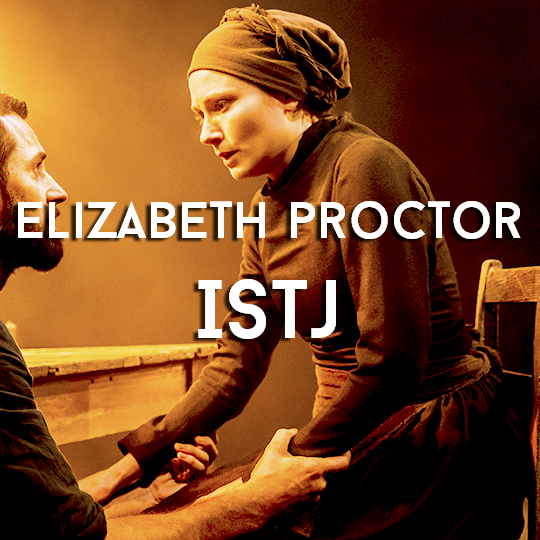
Elizabeth Proctor from The Crucible
ISTJ
by Rebecca
requested by @iifthiswereamovie

Introverted Sensing (Si)
“John, I counted myself so plain, so poorly made, no honest love could come to me! Suspicion kissed you when I did; I never knew how I should say my love. It were a cold house I kept!”
Elizabeth is doing her best to be perfect within the expectations of her community, doing many of her duties as a wife without complaint. She acts as a housekeeper and mother, avoiding the problems of the Salem witch trials until they come to her directly. She does not question the expectations set upon her, always staying within the lines. She is loyal to John and their marriage even until their final moments, finding ways to protect him and their marriage. Despite the intensity that overthrows her life, Elizabeth stays constant and moral through it all.

Extroverted Thinking (Te)
“You’ll tear it free—when you come to know that I will be your only wife, or no wife at all! She has an arrow in you yet, John Proctor, and you know it well!”
Elizabeth is deeply intelligent, able to understand situations as they arise even in the mayhem of the Salem Witch Trials. She determines, correctly, that Abigail is acting to get rid of her so that she may have John all to herself. She is able to take together all of the information in the outside world and synthesize it to come up with the correct conclusion, then acting to prevent it from coming true. She knows when to make demands of others and be stern, particularly when she needs John to stop speaking with Abigail. She is deeply intelligent and presses when she must, always searching for the correct conclusion.

Introverted Feeling (Fi)
“He have his goodness now. God forbid I take it from him!”
Elizabeth struggles with warmth, but throughout the events of The Crucible she forges an intense loyalty and love for her husband. She blames John’s adultery on herself, claiming that she was far too cold towards him and should have been more openly caring.
For much of the play she struggles with opening up about her emotions, finding difficulty in outwardly expressing her feelings She refuses to admit that her husband had an affair with Abigail, lying so she can protect his name and honor. Though this does not align with social norms, it shows that Elizabeth has a morality that is not easily swayed by the mania and falseness of the outside world.

Extroverted Intuition (Ne)
“There be a thousand names; why does she call mine? There be a certain danger in calling such a name—I am no Goody Good that sleeps in ditches, nor Osburn, drunk and half-witted. She’d dare not call out such a farmer’s wife but there be monstrous profit in it.”
The chaos that overtakes Salem with the beginning of the witch trials repels Elizabeth, who prefers to stay in control. When she is named in the witch trials, she points out that she has no good reason to be called a witch due to her usual proper behavior. She, unlike some of the women in Salem, never goes outside the lines of what is expected of her – except for when she lies to protect John. It isn’t until Mary Warren gives her the poppet that she becomes truly intertwined with the witch trials, as she had been waiting by the side up until that point. She would’ve been content to keep her simple and quiet life, but her husband’s affair made chaos unavoidable.


Support us on Patreon and Ko-Fi!

image

Type 1: The Reformer
Wing 9: The Peacemaker

As a Type 1, Elizabeth has a particular idea of what the world should be, even if she has little power to enforce it. Elizabeth follows a stronger moral compass than most of the others in Salem, never falling into the hysteria surrounding witches and pressing her good name. She is critical of others and their behaviors, including her husband for his infidelity, although she also holds herself to an impossibly high standard. When John decides not to sign his name and instead to hang, she supports this decision, saying that he has found his goodness. She firmly believes in a greater judgment than that of the corrupt Salem courts, and finds that John has finally met her standard.

Elizabeth’s wing is a 9, as she tends to keep to herself and avoid causing any kind of trouble in Salem. She rarely bursts out with her disappointment in others, instead keeping her feeling inward to prevent conflict. This restraint makes her moments of expression all the more impactful, as she expresses the anger and sadness that lives just beneath the surface. When she is summoned to the court to say why she dismissed Abigail, she lies to protect her husband’s name. She is aware of the power and the consequences of her words, and wants to protect John even if she cannot protect herself.

theatrembti:

Pierre Bezukhov from Natasha, Pierre, and the Great Comet of 1812
INTP
by Rebecca
requested by @dorkyrose

Introverted Thinking (Ti)
“Abandoned to distraction in order to forget – we waste our lives drowning in wine.”
Pierre has made himself into quite the intellectual throughout all of his reading and studies. He has built up a strong internal system of thought that he can use and apply to a variety of situations, often looking at the war in this manner. He seems to clash with other people because of his view of the world, tending to stick stubbornly to everything he has decided. His personal thoughts are the most important things to him, and he stays to himself, choosing to read instead of going to the opera.

Extraverted Intuition (Ne)
“Do our cannons crack and cry? Do our bullets whistle and sing? Does the air reek with smoke? I wish I were there with death at my heels.”
Pierre desires something more than what he has, stuck at his house with an endless routine of the same thing again and again. He knows there are far more possibilities in the world than he has experienced, and craves to break out from his tiny world. Most of these ideas end up coming out as he talks about how he wishes to join the war and be a part of it all. However, when he is brought into action concerning Anatole and Natasha, he bounces into action and moves from idea to idea with great speed.

Introverted Sensing (Si)
“I used to love, I used to love, I used to be better.”
Though he despises himself for it, Pierre has gotten himself caught within a specific routine. He talks about his habits, saying “I drink and read and drink” and being caught within a life where he can find little meaning. He talks about how he “used to be better” and brings up this idea time and time again, showing a desire to get back to what he used to know. At the end of the day, he does not enjoy the restraints of rotuine, and constantly shows a desire to escape from it with his Ne.

Extraverted Feeling (Fe)
“Fine, I take them back. I take them back, and I ask you to forgive me.”
Pierre seems to avoid conflict and promotes harmony almost as if he is afraid of what will happen if he doesn’t. He is shown as rather philanthropic, always giving out money to those who ask for it – such as Anatole. Towards the end of the show, when he confronts Anatole about the elopement, he ends up allowing Anatole to escape and even asks him for forgiveness. His main outbursts of emotion seem to be through anger, and these are amplified whenever he drinks.

image

Type 4: The Individualist
Wing 5: The Investigator

Pierre is a Type 4, feeling that he does not belong in the world he exists in and drowning in those emotions. He is deeply melancholic from the beginning of the show, saying that he “used to be better.” Throughout Comet he simmers within this feeling, finding jealousy for the others that have supposedly found happiness. In “Dust and Ashes,” he reveals that he feels asleep, that he feels he must fall in love before he can truly experience life again. He believes there is something missing in his life, something external that is just out of his reach.

His wing is a 5, pushing him further into studies and isolation as he searches for meaning in his life. For the most part, he stays at home alone reading and drinking, and if he goes out all he does is continue to drink. He is looking for some kind of truth to help him push forward and find meaning in life, but instead ends up alone and always drinking away his sorrows. In “Letters” Pierre is searching through books, eventually calculating the number of the beast and deciding he is destined to kill Napoleon. He looks for meaning everywhere, perhaps because he struggles to find any inherent meaning within himself.

theatrembti:

Ismene from Antigone
ISFJ
by Rebecca
Note: Quotes taken from the Richard Emil Braun translation.

Introverted Sensing (Si)
“No, Antigone, since the day we both lost our brothers, both in one day, both to each other, I haven’t though of love – happy or painful, either.”
Ismene, who has lived through the loss of nearly her entire family, wants the chaos to end. When Antigone approaches her to bring up the idea of burying Polyneices, she shies away. She sees the past tragedies of their family and claims that they “should be sensible” and obey so that they do not suffer any further. She later steps up and claims she is also to blame for the burial, unwilling to let Antigone die and leave her alone. After so much loss in her life, she clings onto her sister, the one thing she still loves completely and the last member of their family.

Extroverted Feeling (Fe)
“What is life when I’ve lost you? What is there to love in life?”
Ismene is an emotional person who cares deeply about those around her, even if she rarely steps out of the line to show that love. She feels numb and paralyzed by the violence and death that surrounds her, unable to understand her own feelings. This leads her to say nothing makes her happy or hurts her any longer, even though she is often visibly upset by surrounding events. When Antigone is arrested, Ismene weeps and asks to share Antigone’s fate. Her emotions emerge violently and clearly, pushing her to act and claim she is at fault as well in order to align herself with her sister.

Introverted Thinking (Ti)
“A mind does not just grow and then stand. When our lives founder reason deserts us.”
In many ways, Ismene might be seen as the more “sensible” sister when compared to Antigone. She sees her place in Thebes and the situation as one where she should step back and avoid causing troubles. Though she feels she is betraying the dead, she justifies not helping Antigone by seeing their place in society and desiring to stay sensible. She later argues that she too should share the blame, desiring forgiveness for refusing to help Antigone earlier. She sees dying with Antigone as an honor, a means of service to the dead to make up for her former reluctance.

Extroverted Intuition (Ne)
“What can I accomplish? There’s nothing left. What can I do or undo?”
Ismene is less about acting and enforcing change than she is trying to maintain peace and order. She warns Antigone against burying Polyneices, wanting her to avoid the horrible fates that the rest of their family has met. She speaks of feeling utterly powerless and hopeless, seeing only the potential for disaster in the coming future. She worries about losing Antigone, to the point that she is arrested and asks for the same sentence. This seems like a complete and strange shift, until she explains that she cannot bear to live alone, finding far more comfort in dying with her sister than going on in an unsure life without her.


Support us on Patreon and Ko-Fi!

Type 6: The Loyalist
Wing 5: The Investigator

Ismene is a Type 6, terrified of stepping outside of the lines and doing everything in her power to try and keep Antigone safe. She refuses to help Antigone bury Polyneices’s body, knowing that breaking the law will inevitably lead to disaster. This decision may come off as cowardly, but Ismene knows full well that Antigone will most likely be caught and put to death. She shows remarkable loyalty and love when she claims to have helped burying the body, knowing that she cannot bear to live if Antigone is killed. She is terrified of the very real possibility that she would be forced to carry forward in a world where her sister is dead, and thus drops her own safety.

Ismene’s wing is a 5, demonstrating her ability for logical thought and looking deeper into situations. Though she agrees with Antigone’s ideological decision to bury Polyneices, she can see logically where breaking the edict will go. Her predictions that Antigone will be caught and killed end up coming to fruition, as it is the logical course of events. Ismene is isolated for much of the play and indeed much of her life, as she is separated from Antigone. She is afraid of engaging with the world at such a dangerous time, and ends up abandoned by the one person she has left.

theatrembti:

image

The Leading Player from Pippin
ESFP
by Rebecca
requested by @therobopickle
Note: I am referring to the Broadway revival of Pippin as my major source, so I will be referring to the Leading Player with she/her pronouns.

Extraverted Sensing (Se)
“We’ve got magic to do, just for you.’”
The Leading Player is, first and foremost, a performer who does all she can to thrill the audience and keep the show running. She presents herself as a marvelous performer using magic, lights, colors, and costumes to create something incredible. She mentions how she enjoys “Simple Joys” in life, which require her to live in the moment and use the senses to engage fully. Another facet of her character, which is more sinister, is revealed as she attempts to seduce Pippin to do the Grand Finale by presenting all of the superficial but flashy aspects of the show.

Introverted Feeling (Fi)
“Ladies and gentleman, we apologize sincerely for not giving you the finale we promised. It seems our extraordinary young gentleman has decided to compromise his aspiration.”
The Leading Player is driven by her own personal feelings about how her show should run and how everyone else should fit in it. She has determined precisely how she wants everything to run, and if something goes amiss then she ends up getting furious. This is seen as she constantly criticizes Catherine for messing up the show, and fully presented as she lashes out when Pippin refuses to do the Grand Finale. She never changes her mind regardless of how difficult Catherine and Pippin are, and instead persists to put on the show by moving after Theo.

Extraverted Thinking (Te)
“You’ll pull through in just a while, ‘cause you’re on the right track!”
While her plans are not immediately revealed, it is shown that the Leading Player schemes and plots to guide the show toward the Grand Finale. Many of her actions seem calculated in order to move Pippin toward the Grand Finale, and she orchestrates the entire show and all of the players for this purpose. She is a strong leader as the Leading Player, who controls the entirety of the players with ease. However, when things appear to be out of her control it is clear that she struggles, as she thrives as the head of it all.

Introverted Intuition (Ni)
“His life seemed purposeless and flat. Aren’t you glad you don’t feel like that?”
Most of the Leading Player’s actions are guided toward one goal that she fixates on, looking toward the future with little depth. Her one guiding light comes in the form of creating the perfect Grand Finale where Pippin will throw himself into flames, and everything she does is an attempt to push him to this fate. Her actions appear to come from a narrow-minded view where she cannot imagine anything else happening. Then, when things do not go according to this plan for the future, she ends up unable to act and becomes furious.

Type 8: The Challenger
Wing 7: The Enthusiast

The Leading Player is a powerful and intense leader, a Type 8 who takes and keeps control. She always seems to know exactly what to do to drive Pippin forward, always drawing attention and pushing onward. This is best seen in “On the Right Track,” where the Leading Player quickly snaps Pippin back into action through her intervention. She shows several moments of anger, but finally snaps when Pippin refuses to do the Finale. She cannot stand the idea that someone is not doing as she says, rejecting her authority, slipping past her power – so she takes down the entire show.

The Leading Player is very much interested in the exciting and beautiful, letting it seduce others into her performances. She entices the audience by expressing the magic that will happen within the show, listing everything that audiences can expect and enjoy. She uses this list as a way to drive her own ideas and thoughts forward, as she slowly but surely pushes through to the Finale where she intends everything to come together as the perfect performance. The Finale, though morbid, is also something of great excitement and, to the Leading Player, immense beauty. This is the aspect that she brings to the forefront when revealing it to Pippin, expressing how it will be the most powerful and perfect way for his life to end.